
Introduction
A bucket elevator is the most common way to move bulk cement, raw meal, clinker, and additives vertically. It looks simple — a chain or belt with buckets — but the wrong choice means carryback, spillage, belt slip, or a sudden shutdown that blocks the entire process line.
Selecting a bucket elevator comes down to four things: what material you lift, how much, how high, and how abrasive. This guide walks through the choices that matter and helps you avoid the most common mistakes engineers make when sizing one.
1. Short Answer
- Fine, free-flowing powders (cement, raw meal):centrifugal-discharge belt bucket elevator.
- Heavy, abrasive lumps (clinker, aggregate):positive-discharge chain bucket elevator.
- Longer heights (>30 m):belt-type, lighter and quieter.
- High temperature or heavy lumps:chain-type, more robust but louder.
- Always oversize capacity by 15–20%— an undersized elevator is a bottleneck, and a slightly oversized one costs almost nothing in extra power.
2. What Is a Bucket Elevator?
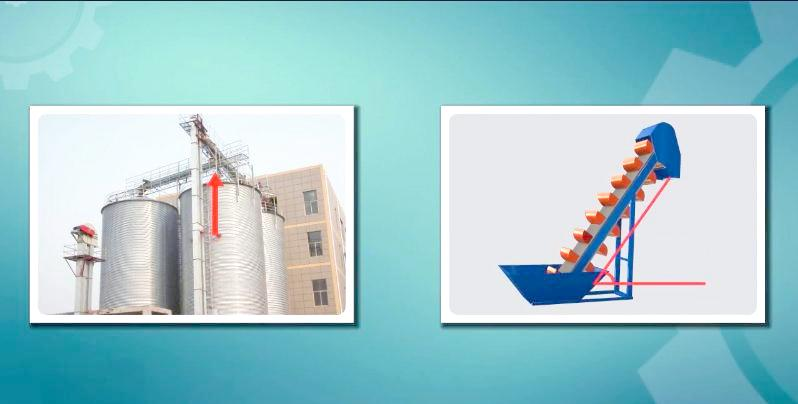
A bucket elevator is a vertical (or near-vertical) conveyor that uses buckets bolted to a belt or chain to lift bulk material from a boot at the bottom to a discharge chute at the top. Material enters at the boot, is scooped by the buckets, carried up the casing, and discharged at the head pulley as the buckets turn over.
The four main parts:
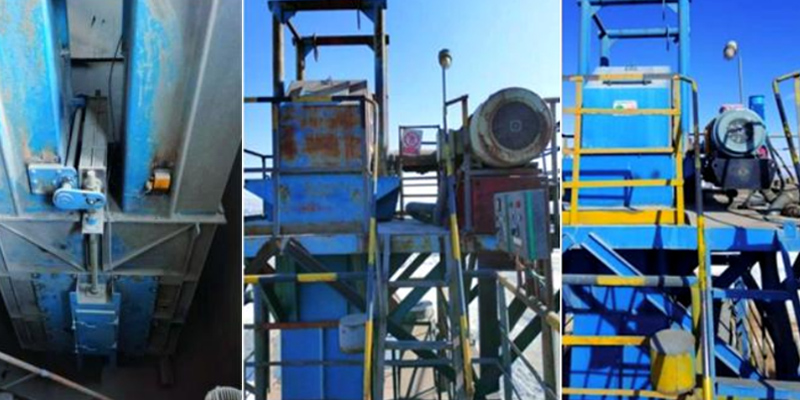
- Head section— drive pulley/chain sprocket, motor, brake, discharge chute.
- Boot section— tail pulley, take-up, inlet.
- Casing— bolted steel sections enclosing the buckets; often comes in single or double trunk.
- Belt or chain with buckets— the moving part that actually lifts material.
3. Belt Type vs Chain Type
| Factor | Belt Bucket Elevator | Chain Bucket Elevator |
| Typical material | Fine powders, granular material | Heavy lumps, abrasive material |
| Max lump size | Up to ~50 mm | Up to ~100+ mm |
| Max temperature | ~120°C (special belts higher) | Up to 200–300°C |
| Max height | Up to 60–80 m | Up to 40–50 m |
| Speed | Higher (1–1.6 m/s) | Lower (0.4–0.8 m/s) |
| Noise | Quieter | Louder |
| Maintenance | Belt tracking, splice inspection | Chain elongation, sprocket wear |
| Cost (capital) | Lower for powders | Higher for heavy duty |
| Best for | Cement, raw meal, fly ash, grain | Clinker, limestone, slag |
Rule of thumb: powders and fine granules go on a belt; clinker, rock, and hot material go on a chain.
4. Discharge Style: Centrifugal vs Positive
4.1 Centrifugal Discharge
Buckets are spaced apart and run at relatively high speed. At the head pulley, material is thrown out by centrifugal force into the discharge chute. This is the most common style for cement and raw meal.
- Best for: free-flowing, non-sticky powders and granules.
- Not for: very sticky or sluggish material, which will fall back down the boot.
4.2 Positive (Gravity) Discharge
Buckets are close together on a chain and run slower. Material discharges by gravity as the chain turns over the head sprocket.
- Best for: sluggish, flaky, or fibrous material; high temperatures.
- Used for: wet gypsum, slag, bulky products.
5. Key Selection Parameters
5.1 Capacity (t/h)
Start from the required throughput, then add a 15–20% safety margin. Don’t size the elevator to exactly match your feed rate — feed rates fluctuate, and a bottleneck elevator blocks the whole line.
5.2 Material Properties
- Bulk density— determines bucket volume and speed.
- Lump size— must fit inside the bucket; oversized lumps damage buckets and cause jams.
- Abrasiveness— dictates bucket material (mild steel vs wear-resistant steel like HARDOX).
- Temperature— high temperature means chain or special heat-resistant belt.
- Flowability— sticky or damp material needs positive discharge and smooth bucket bottoms.
5.3 Lift Height
Measure from boot inlet to head discharge. Belt elevators are more economical above ~30 m; chain elevators are usually chosen below that for heavy lumps.
5.4 Inlet and Discharge Orientation
Decide whether material enters on the forward or reverse side of the boot and whether discharge is tangential or top-mounted. These affect chutes and layout.
6. Bucket Materials
| Material | Use For |
| Mild steel (painted) | Non-abrasive powders (cement, fly ash) |
| Galvanized steel | Damp, outdoor service |
| Wear-resistant steel (HARDOX/NM400) | Clinker, limestone, abrasive material |
| Stainless steel | Food, chemical, corrosive duties |
| Plastic / nylon | Light, non-abrasive, food-grade |
7. Common Bucket Elevator Problems
| Problem | Likely Cause | Fix |
| Spillage at boot | Wrong inlet position, back-leakage | Adjust inlet, install baffle |
| Carryback down the return leg | Buckets not discharging fully, sticky material | Increase speed, switch to positive discharge |
| Belt slip | Low tension, wet material, overload | Adjust take-up, check loading |
| Excessive vibration | Misaligned head, worn pulley lagging | Realign, re-lag pulley |
| Chain elongation (chain type) | Wear, overloading | Adjust take-up; replace chain when elongation > 2% |
| Bucket deformation | Oversized lumps, jam, impact | Add scalping screen upstream |
| Dust emission | Leaky casing, no vent | Seal casing, add vent filter to head |
8. Quick Selection Checklist
| Your Situation | Recommendation |
| Cement or raw meal powder, up to 50 m | Belt, centrifugal discharge |
| Clinker or limestone lumps | Chain, positive or centrifugal |
| Hot material (>150°C) | Chain, heat-resistant |
| Height >50 m, fine powder | Belt (high-strength steel-cord) |
| Sticky or damp material | Positive discharge chain |
| Outdoor, damp environment | Galvanized casing, sealed bearings |
9. FAQ
Q1: How do I calculate bucket elevator capacity?
Capacity depends on bucket volume, bucket spacing, belt speed, and material bulk density. The supplier sizes this from your required t/h and material density — give them both.
Q2: Belt or chain for cement?
Belt. Cement is a fine, free-flowing powder and belt elevators are quieter, cheaper, and more efficient at height.
Q3: How tall can a bucket elevator go?
Belt elevators routinely reach 60–80 m; chain elevators are usually limited to 40–50 m due to chain weight.
Q4: How often should I inspect buckets?
Inspect at least annually during a planned shutdown; look for bent buckets, loose bolts, and wear on the leading edge.
Q5: What is the most common sizing mistake?
Sizing the elevator exactly to nameplate capacity instead of adding 15–20% margin. A slightly oversized elevator costs almost nothing in power and avoids becoming the line bottleneck.
10. Summary
Selecting a bucket elevator is a process of elimination: powders go on belt, lumps go on chain; fine material discharges centrifugally, sticky material discharges by gravity; and always add a capacity margin. Get these four decisions right and the elevator will run quietly for years.
Need help sizing a bucket elevator for your cement plant? Contact Darko Cement. We design and supply belt and chain bucket elevators for raw meal, cement, clinker, and additives, and our engineers will match the elevator to your material, height, and throughput. Conveying horizontally after the elevator? See our Air Slide vs Belt Conveyor Guide and Screw vs Belt Conveyor Guide.