



Industrial Cyclone Dust Collector
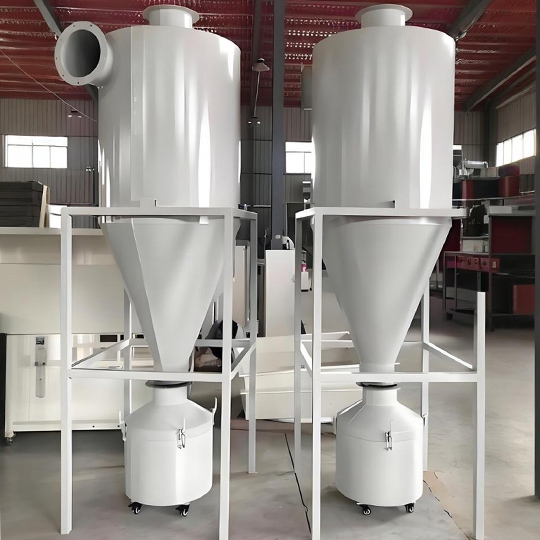
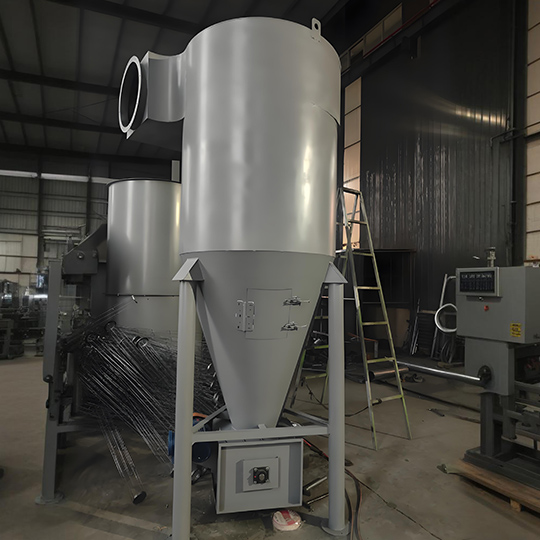
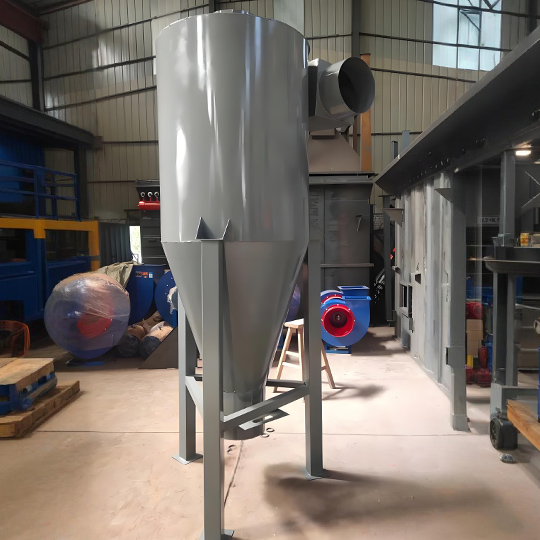
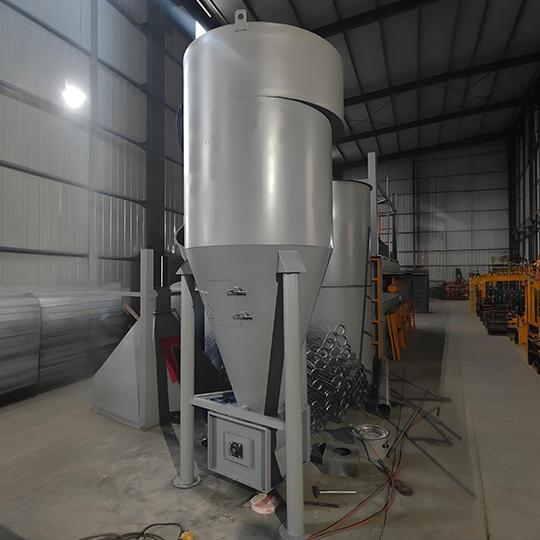
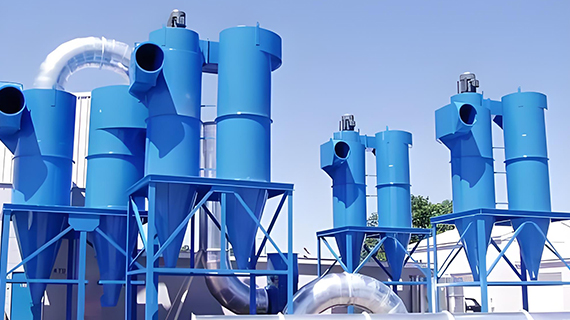
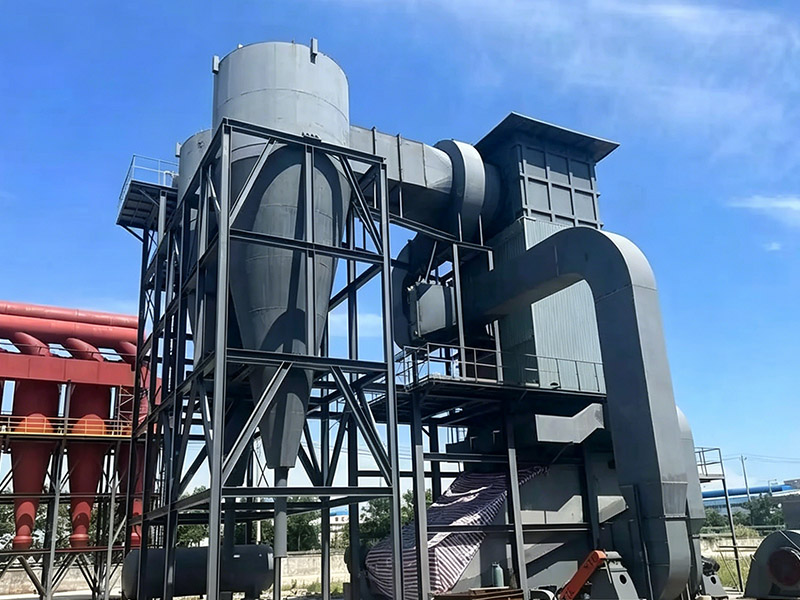
A cyclone dust collector is a type of dust removal device. It consists of an inlet pipe, an outlet pipe, a cylindrical body, a conical body, and a hopper. The dust removal mechanism involves forcing the dust-laden airflow into a rotational motion, where centrifugal force separates and captures dust particles on the inner wall. The particles then fall into the hopper under the influence of gravity.
- Simple Structure
- Robust and Durable
- Easy Maintenance
- Low Energy Consumption
- Effective Pre-Dedusting
Reliable Pre-separation for Harsh Cement Environments
Darko’s Industrial Cyclone Separator is specifically engineered for the high-abrasion environments of cement plants. Whether you are looking for an efficient cyclone dust collector to reduce the load on your baghouse or a robust separator for material recovery in the grinding process, our equipment delivers consistent performance.
Designed to handle high-volume bulk materials including Ordinary Portland Cement (OPC) and Pozzolana Portland Cement (PPC), Darko cyclones ensure maximum separation efficiency with minimal energy consumption.
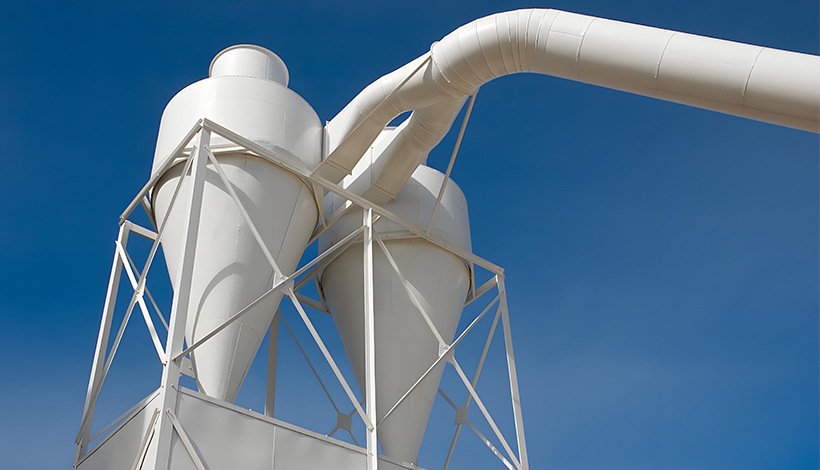
- Technical Specifications & Application Advantages
- Basic Structure
- Core Performance
- Main Application Fields
- Model Selection: Flow Rates, Dimensions & Weights
| Feature | Specification | Application in Cement Industry |
| Capacity | Up to 3,000 TPH | Raw Meal & Clinker Handling |
| Material | Heavy-duty Carbon Steel / SS304 / AR Plate | High-Abrasive Dust Points |
| Lining Options | Alumina Ceramic Tiles / Manganese Steel | Grinding Mill & Kiln Tail Discharge |
| Separation Efficiency | 95% – 99% (>10μm) | Pre-filtering for Baghouse Systems |
| Inlet Configuration | Tangential / Helical / Axial | Airflow Optimization & Turbulence Reduction |
The cyclone dust collector consists of five core components: an inlet pipe, exhaust pipe, cylindrical body, conical hopper, and dust collection chamber. Characterized by its simple structure, this system offers significant advantages in manufacturability, installation, and maintenance, with relatively low capital and operational costs. It has become widely adopted for separating solid/liquid particles from gas streams or solid particles from liquids.
-
Generates centrifugal forces 5-2500 times greater than gravity, enabling significantly higher efficiency than gravity settling chambers
-
Achieves >90% collection efficiency for particles above 5μm in standard configurations
-
Multi-cyclone arrays can capture 80-85% of 3μm particles
-
Operates effectively under extreme conditions (1000°C, 500×10⁵Pa) when constructed with specialized alloys/ceramics
-
Maintains 500-2000Pa pressure drop (optimized for medium-efficiency applications)
- Raw material powder collection for raw material grinding system
- High temperature dust treatment after clinker cooling process
- Dust emission control during cement silo feeding and discharging
- Gas-solid pre-separation for rotary kiln preheater system
- Widely used in mining, metallurgy, thermal power and other industrial dust removal fields
Note: Pressure drop (Loss) is calculated based on specific site conditions and inlet velocities.
| Model | Flow Range (m³/h) | @12m/s | @15m/s | @18m/s | Dimensions (Φ×L mm) | Weight (X/Y Type kg) |
| YX-5.5 | 1000 – 1500 | 1000 | 1200 | 1500 | Φ552 × 950 | 94 / 84 |
| YX-7.5 | 2000 – 3000 | 2000 | 2500 | 3000 | Φ762 × 1360 | 161 / 145 |
| YX-9.6 | 3000 – 4500 | 3000 | 3800 | 4500 | Φ996 × 1640 | 262 / 235 |
| YX-11 | 4000 – 6000 | 4000 | 5000 | 6000 | Φ1110 × 1880 | 341 / 310 |
| YX-12 | 4900 – 7300 | 4900 | 6100 | 7300 | Φ1230 × 2090 | 416 / 376 |
| YX-13 | 5700 – 8600 | 5700 | 7100 | 8600 | Φ1330 × 2225 | 497 / 447 |
| YX-14 | 6700 – 10100 | 6700 | 8400 | 10100 | Φ1445 × 2420 | 568 / 512 |
| YX-15 | 8300 – 12500 | 8300 | 10400 | 12500 | Φ1599 × 2685 | 697 / 617 |
| YX-16 | 10000 – 15200 | 10000 | 12600 | 15200 | Φ1765 × 2950 | 840 / 765 |
| YX-17 | 11500 – 17200 | 11500 | 15200 | 17200 | Φ1890 × 3165 | 989 / 903 |
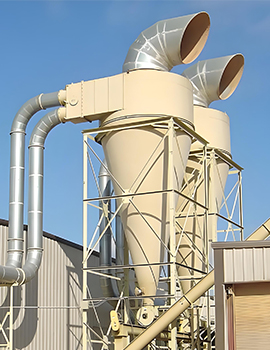
How Do Cyclone Separators Work?
A cyclone separator (or cyclone dust collector) uses centrifugal force to separate solids from gas streams without moving parts. The process follows four key stages:
- Tangential Entry: Dust-laden air enters through a tangential inlet, creating a high-speed downward spiral.
- Centrifugal Separation: The spiral motion flings heavy particles (like cement clinker) toward the inner walls.
- Dual Vortex Action: An outer vortex carries dust down to the hopper, while a cleaned inner vortex ascends and exits through the vortex finder.
- Material Discharge: Separated solids are collected at the bottom, typically discharged via a Rotary Airlock Valve to maintain the pressure seal.
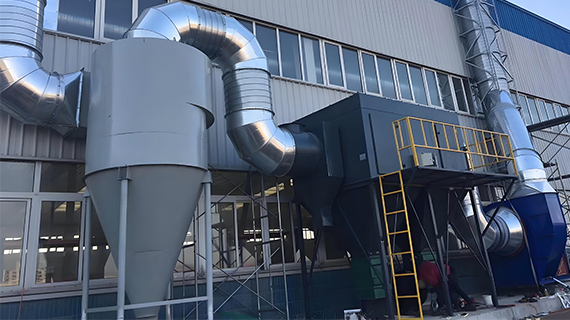
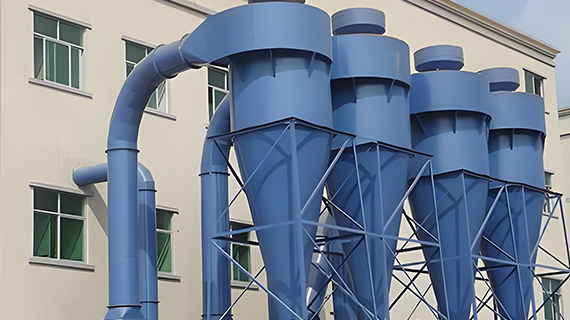
Advantages of Cyclone Dust Collectors
Cyclone dust collectors offer multiple benefits, including a simple structure, low cost, and easy maintenance. They operate without filter media, reducing running costs, and can handle high-temperature (up to 400°C) and high-concentration dust. With strong corrosion resistance, they suit various industrial environments. Their moderate pressure drop (500-2000 Pa) can be further optimized with resistance-reducing rods. They efficiently capture particles above 5μm (80%-95% efficiency) and can be specially designed for 3μm particles. Compact in size, they fit space-constrained applications. As dry separation systems, they prevent wastewater pollution and are widely used in cement, metallurgy, power generation, and other industries.
Structural Features of the Cyclone Dust Collector
-
Straight-through side chamber: Effectively eliminates the “upper ash ring” phenomenon, preventing clogging.
-
Cylinder-like cone structure: Minimizes the formation of a “lower ash ring,” avoiding the rebound of coarse dust particles in high-wear areas. This enhances service life and dust collection efficiency.
-
Optimized cyclone design: Effectively prevents secondary dust re-entrainment (dust re-scattering).
Engineered for Durability in High-Abrasion Environments
Advanced Wear Protection (Ceramic Lining)
Cement dust is highly abrasive. To ensure long-term reliability, Darko cyclone separator can be integrated with Alumina Ceramic Tiles or High-Manganese Steel linings. These options significantly extend equipment life compared to standard carbon steel alternatives.
High-Efficiency Particle Separation
The optimized aerodynamic structure maintains high collection efficiency (up to 99% for particles >10μm), making it an ideal pre-separator for kiln tail gases and clinker cooling systems.
High-Temperature Stability
Each unit is engineered to withstand process temperatures up to 450°C (842°F), ensuring stable operation in rotary kiln preheater systems and hot clinker handling.
Energy-Efficient CFD Design
Utilizing CFD-optimized internal geometry, Darko cyclone separators minimize pressure drop and air resistance, directly reducing the operational energy costs of ID fans.
High-Efficiency Dust Collection Solutions
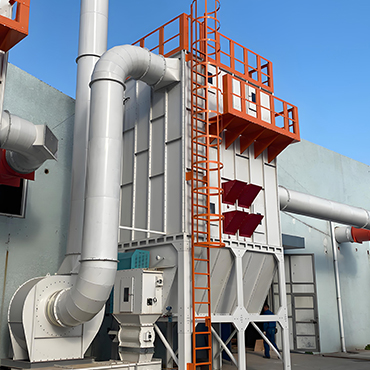
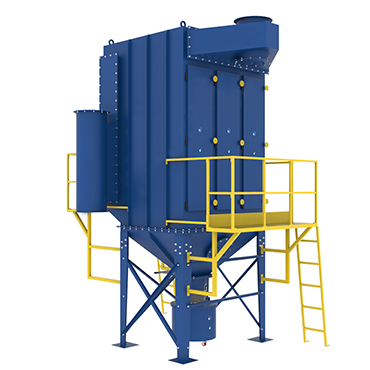

Industry-Leading Cyclone Dust Collector Manufacturer
As a leading manufacturer of cyclone dust collectors, DARKO provides over 10 years of specialized expertise in industrial dust control. Our ISO-certified systems, exported to more than 30 countries, deliver robust and cost-effective dust removal solutions for industries such as cement, metallurgy, chemical, and lithium battery production. Combining high-efficiency separation with durable, low-maintenance operation, DARKO cyclone collectors are engineered for reliability in the most demanding environments.
Cyclone dust collectors feature a simple structure, low cost, and easy installation/maintenance. They are ideal for capturing large, dry, non-fibrous dust particles and widely used in metallurgy, foundry, sandblasting, building materials, and refractory industries. Available in single-tube, double-tube, and multi-tube configurations, they can be tailored to different air volume requirements.
Darko’s Industrial Cyclone Solutions
We offer various cyclone dust collectors to meet diverse process needs:
-
By Structure
-
Single Cyclone: Basic design for small-scale dust collection
-
Multi-stage Cyclone: Multiple units for enhanced large-scale processing
-
-
By Airflow Direction
-
Axial-flow: Higher efficiency with axial airflow
-
Cross-flow: Specialized for specific particle types
-
-
By Efficiency
-
High-efficiency: For fine particle capture
-
Standard: For larger particles
-
-
By Inlet Design
-
Side-inlet: For specialized processes
-
Top-inlet: For specific applications
-
-
By Industry Application
-
Cement production
-
Metallurgy & foundry
-
Chemical/pharmaceutical processes
-
-
By Gas Temperature
-
High-temperature (up to 400°C)
-
Standard temperature
-
For technical consultation or product selection, please contact our sales team for professional support.
-
Pros: Simple structure, low maintenance, no moving parts, handles high temperatures/pressure.
-
Cons: Low efficiency for fine particles (<5μm); often needs a secondary filter (e.g., baghouse).
Key parameters:
-
Cylinder diameter (D), inlet dimensions (width × height), exhaust pipe diameter (0.5D), cone angle (10°–20°).
-
Use standard models (Lapple/Stairmand) or CFD simulations.
Yes, but use heat-resistant materials (e.g., stainless steel or refractory-lined carbon steel). Typically handles up to 400°C+, outperforming baghouses.
We use specialized ceramic-to-metal bonding technology in high-velocity zones to ensure the internal walls remain intact under constant bombardment by fine cement particles.
Yes, Darko provides modular designs and customized inlet/outlet configurations to match your current ductwork and space constraints.