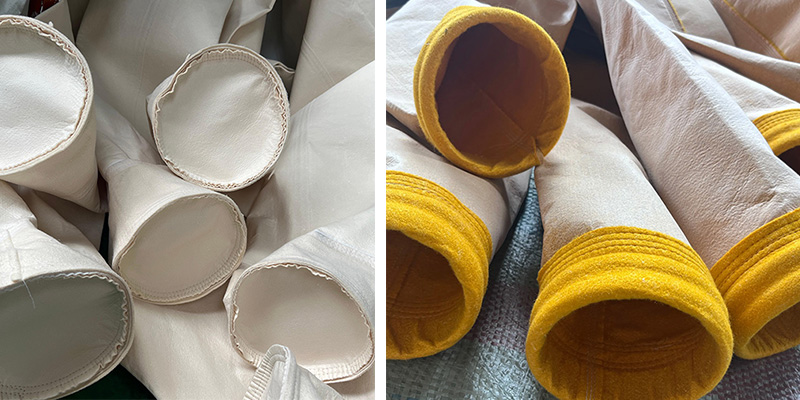
Filter bags are the only consumable in a baghouse that directly determines both your emission number and your operating cost. Yet material selection is still done by habit in most plants: “we have always used X.” This guide gives you the decision logic instead — the actual failure mechanisms, the numbers behind each fiber, and a selection table by cement plant location.
The 30-Second Selection Table
Use this as a first pass, then validate against the four failure mechanisms further down.
| If your gas is… | Choose | Why | Watch out for |
|---|---|---|---|
| 140–190 °C, acidic, low O₂ (<8%) | PPS | Excellent acid + hydrolysis resistance, 99.95% efficiency | Oxidises fast if O₂/NOx is high |
| 150–200 °C, dry, abrasive dust | Nomex / Aramid | Best tensile and abrasion strength of the five | Hydrolyses in hot wet gas; pH 4–9 only |
| Up to 260 °C with aggressive acid/alkali | PTFE | Near-universal chemical resistance, non-stick surface | Highest cost; modest flex life |
| 200–240 °C, fine or sticky dust | P84 | Multi-lobed fiber → +40% surface area, low ΔP (<800 Pa) | Poor resistance to strong alkali and hydrolysis |
| 200–280 °C, dry, low cleaning frequency | Fiberglass | Highest temperature rating, ~50% cheaper than PTFE | Brittle — fails under frequent pulse cleaning |
| <130 °C, dry, non-abrasive | Polyester | Lowest capital cost, 99.5% efficiency | Hydrolyses above 130 °C with moisture |
| <130 °C, humid, risk of condensation | Acrylic | Best hydrolysis resistance in the low-temperature class | Low temperature ceiling |
Why Material Choice Drives Total Cost, Not Just Bag Price
A baghouse operator’s budget line for filter media looks small next to the cost of the collector itself. That is misleading. Over a ten-year life, the true cost stack looks like this:
- Bag replacement purchase — the visible cost.
- Labour for change-out — typically 1.5–3× the bag price on large collectors, and often requires a production stop.
- Lost production during the stop — on a 5,000 t/d clinker line this dwarfs everything else.
- Energy — a blinded or over-caked bag raises differential pressure, and fan power rises roughly linearly with ΔP. Moving from 1,200 Pa to 1,800 Pa can add 15–25% to filter fan power, year after year.
- Non-compliance risk — one failed bag in a plenum can push stack readings over the permit limit.
This is why the cheapest bag per square metre is rarely the cheapest per tonne of cement. A bag at 2× the price that lasts 2× longer already wins on purchase plus labour alone; on energy and uptime it wins decisively. If you want the full economic model, see our guide to selecting dust filter bags for the cement industry.
The Five Materials at a Glance
Figures below are for standard needle-felt constructions; finishes such as PTFE lamination change the numbers.
| Material | Continuous | Peak | Hydrolysis | Oxidation | Abrasion | Acid / Alkali | Relative cost* |
|---|---|---|---|---|---|---|---|
| PPS | 190 °C / 374 °F | 232 °C (30 min) | Very good | Poor | Good | Very good / good | 3× |
| Nomex / Aramid | 200 °C / 392 °F | 240 °C | Fair | Good | Excellent | Good (pH 4–9) | 3× |
| PTFE | 260 °C / 500 °F | 280–290 °C | Excellent | Excellent | Good | Excellent (all) | 6–8× |
| P84 (polyimide) | 240 °C / 464 °F | 260 °C | Fair | Good | Good | Good / fair | 5–6× |
| Fiberglass | 280 °C / 536 °F | 300 °C (30 min) | Good (dry) | Excellent | Poor (flex) | Good; avoid HF | 2× |
| FMS (PTFE + glass) | 260 °C / 500 °F | 300 °C | Very good | Very good | Good | Excellent (pH 1–12) | 4× |
| Polyester | 130 °C / 266 °F | 150 °C | Poor | Good | Good | Fair | 1× |
| Acrylic | 130 °C / 266 °F | 140 °C | Very good | Good | Fair | Good | 1.5× |
* Indicative price index per m² of media, polyester = 1. Actual pricing depends on weight, finish, diameter and quantity.
Material Deep Dive
1. PPS — The Chemical Workhorse (190 °C)
PPS (polyphenylene sulfide) needle felt is the default choice for hot, acidic, oxygen-lean gas. It combines three properties that rarely appear together: strong acid resistance, genuine hydrolysis resistance, and a 190 °C continuous rating — at roughly a third of PTFE’s price.
- Specification: 100% PPS needle felt, 500–750 g/m², air permeability 10–15 m³/m²/min @ 200 Pa, 99.95% efficiency at PM2.5.
- Sweet spot: coal-fired boiler baghouses downstream of FGD, waste incineration with controlled oxygen, chemical process gas.
- Track record: in harsh acidic conditions PPS typically delivers roughly double the service life of polyester.
Full data sheet: PPS filter bags.
2. Nomex / Aramid — The Abrasion Champion (200 °C)
Meta-aramid (Nomex is DuPont’s trade name; generic aramid performs comparably) is the mechanical performer of the group. It has the highest tensile and abrasion resistance here, which makes it the standard for hot, dry, abrasive dust.
- Specification: aramid fiber, 450–600 g/m², 1.8–2.5 mm, tensile ≥1,000 N/5 cm (MD) and ≥1,200 N/5 cm (CD), continuous ≤200 °C, peak 240 °C, >99.99% efficiency.
- Chemical window: genuinely good between pH 4 and pH 9 — outside that window, look elsewhere.
- Sweet spot: cement kiln head and grate coolers, clinker handling, asphalt plants, foundries.
Full data sheet: Aramid (Nomex) filter bags.
3. PTFE — The Ceiling on Both Temperature and Chemistry (260 °C)
PTFE is what you specify when everything else has been ruled out. It is effectively inert across the whole pH range, holds 260 °C continuously, absorbs no moisture at all, and its non-stick surface releases sticky cake that blinds other media.
- Specification: 100% PTFE membrane laminated on a fiberglass or PPS base fabric; >99.99% efficiency down to PM0.3; compliant with ISO 16890, EPA and GB/T 6719.
- The hidden benefit: a PTFE membrane moves filtration from depth filtration to surface filtration. Cake releases cleanly, ΔP stays flatter, and pulse cleaning frequency drops — which cuts compressed air and extends life further.
- Reality check on cost: typically 6–8× polyester per m², and up to 3× the service life of conventional media in severe service. It pays off in aggressive chemistry, high-value product recovery, and tight emission permits — not on a mild, dry, 90 °C dust stream.
Full data sheet: PTFE filter bags.
4. P84 — The Efficiency Specialist (240 °C)
P84 polyimide has one structural advantage no other fiber matches: the fiber cross-section is irregular and multi-lobed rather than round. That geometry gives roughly 40% more specific surface area than circular fiber at the same weight, so it captures finer dust without pushing resistance up.
- Specification: 100% virgin P84 staple fiber on a PTFE spun-yarn scrim; continuous 240 °C, maximum 260 °C; stable running resistance below 800 Pa.
- Sweet spot: fine, sticky or humid dust where you need high efficiency at low ΔP — kiln inlet gas, waste incineration, non-ferrous smelting.
- Construction note: welded (ultrasonic) seams rather than sewn seams are worth specifying on wet service, because needle holes are a common leak path.
Full data sheet: P84 filter bags.
5. Fiberglass — Highest Temperature, Lowest Cost per m² (280 °C)
High-silica fiberglass felt handles the highest continuous temperature of any common media — 280 °C, with peaks to 300 °C and less than 1% shrinkage at that temperature — at about half the cost of PTFE. That combination makes it the default for kiln inlet, clinker cooler and smelting gas.
- Specification: high-silica fiberglass (PTFE coating optional), 650–900 g/m², continuous 280 °C, peak 300 °C (30 min), 99.9% at 1.0 µm, permeability 10–15 m³/m²/min @ 125 Pa.
- Chemistry: good in dry gas; avoid hydrofluoric acid and hot phosphoric acid.
Full data sheet: Fiberglass filter bags.
Also Worth Considering: FMS, Polyester and Acrylic
- FMS (50% PTFE + 50% fiberglass) — 260 °C continuous, pH 1–12, about twice the life of standard fiberglass. This is often the most economical answer where the gas is too hot or too corrosive for PPS but PTFE cannot be justified.
- Polyester — the default below 130 °C. Excellent value wherever the gas is cool and dry; hydrolyses quickly once heat and moisture combine.
- Acrylic — the right choice for cool but humid gas, where polyester would hydrolyse. Common on raw mills and material handling with condensation risk.
The Five Mechanisms That Actually Kill Filter Bags
Most premature bag failures trace back to one of five mechanisms. Diagnosing which one is at work tells you what to change — and material is only one of the variables.
1 Thermal excursion
Short over-temperature events shrink, harden or embrittle fibers. Signs: bags stiff, glazed, shrunk tight on the cage, or with melted areas near the inlet.
- Fix: re-rate with 20–30 °C headroom; add a cold-air bleed valve or pre-cooler; check temperature interlocks.
2 Hydrolysis
Heat plus moisture breaks polymer chains. Hits polyester hardest, then aramid and P84. Signs: uniform loss of tensile strength, bags tear like paper, no visible burning or chemical staining.
- Fix: switch to PPS (if O₂ allows), acrylic (below 130 °C) or FMS; keep gas above the dew point; eliminate air in-leakage at hoppers and doors.
3 Oxidation
Oxygen and NOx attack the polymer at elevated temperature. This is the classic PPS failure and it is frequently misdiagnosed as a “bad batch of bags.” Signs: brownish discolouration, brittleness, cracking at cage contact lines.
- Fix: measure actual O₂ and NOx at the baghouse inlet. Move to PTFE, FMS or fiberglass where oxygen is high.
4 Chemical attack below the acid dew point
When gas drops below its acid dew point, sulfuric or hydrochloric acid condenses onto the media and dissolves it. Signs: localised thinning and holes, often at the bottom third of the bag or in the coldest corner of the collector.
- Fix: raise operating temperature above dew point, insulate the casing, seal air in-leakage, and select media rated for the actual acid load.
5 Mechanical wear and flex fatigue
Abrasion from coarse dust, plus flexing against the cage at every pulse. Hits fiberglass hardest. Signs: holes along cage wire lines, thinning at the bag bottom, failures concentrated where inlet flow impinges.
- Fix: reduce pulse pressure and frequency; improve inlet distribution with baffles or a cyclone pre-separator; upgrade cage finish. Cage quality is decisive here — see how to choose the right filter bag cage and what causes filter bag damage.
Filter Bag Selection by Cement Plant Location
This is where the theory meets the plant. Temperatures are typical ranges — always confirm against your own measured data.
| Location | Typical temp. | Gas and dust character | Recommended media | Key risk |
|---|---|---|---|---|
| Kiln inlet / preheater | 120–200 °C | High moisture, alkaline, condensation risk, temperature swings | P84 · FMS · PTFE-coated fiberglass | Hydrolysis, condensation |
| Kiln head / grate cooler | 200–280 °C | Coarse, abrasive clinker dust; very high excess air (high O₂) | Aramid (Nomex) · fiberglass · P84 | Abrasion + oxidation (avoid PPS) |
| Coal mill | 70–100 °C | Combustible dust — explosion risk | Antistatic needle felt (conductive fiber or scrim) | Static ignition — see explosion-proof dust collectors |
| Cement mill | 90–120 °C | Dry, fine, moderately abrasive | Polyester · acrylic · aramid | Blinding if moisture enters |
| Raw mill | 90–150 °C | Moist, condensation-prone | Acrylic · PPS (low O₂) · polyester with water-repellent finish | Hydrolysis |
| Clinker / bulk loading | Ambient–120 °C | Abrasive, intermittent duty | Polyester · aramid | Abrasion |
| Packing and conveying | Ambient | Fine cement dust, high concentration | Polyester · acrylic | Cost optimisation |
| Kiln bypass | 250–350 °C+ | High alkali, high chloride, extreme | Requires pre-cooling, then fiberglass or FMS | Beyond standard media limits — consult engineering |
Beyond the Base Fiber: Finishes That Change the Outcome
Two bags made from the same base fiber can perform completely differently depending on finish. Specify these explicitly — they are frequently omitted from purchase orders.
- Singeing — burns off surface fuzz so cake releases more cleanly.
- Calendering — smooths the surface; reduces dust penetration into the felt.
- Heat setting — essential for high-temperature service; prevents shrinkage and deformation in service.
- PTFE impregnation / coating — improves chemical resistance and lubricity; extends life in corrosive or sticky duty.
- ePTFE membrane lamination — converts to surface filtration: highest efficiency, flattest ΔP curve, easiest cleaning. Costs more and the membrane can be abraded, so pair it with non-abrasive dust or a robust base felt.
- Antistatic treatment — stainless-steel fiber blended into the felt, or a conductive scrim. Mandatory on coal mills and any combustible dust.
- Water and oil repellency — valuable where condensation or oil mist is present.
Seam construction matters just as much: sewn seams are standard, but ultrasonically welded seams eliminate needle-hole leakage and are worth specifying on high-humidity service or very tight emission limits.
A Five-Step Selection Framework
- Measure temperature properly. Continuous, peak, and duration of excursions — plus how often the collector starts up cold. Add 20–30 °C headroom to the continuous figure.
- Get the gas chemistry. O₂ %, NOx, SOx, moisture %, and the acid dew point. Oxygen and NOx decide whether PPS is viable at all; dew point decides whether condensation protection is needed.
- Characterise the dust. Particle size distribution, abrasiveness, stickiness, hygroscopic behaviour, and whether it is combustible (which mandates antistatic media).
- Check the cleaning regime. Pulse pressure, interval and air-to-cloth ratio. Aggressive cleaning rules out fiberglass and short-lived membranes.
- Cost it over the full cycle. Compare (bag price + labour + downtime + energy) ÷ expected hours of life — not price per bag.
Seven Mistakes That Shorten Filter Bag Life
- Specifying to the normal temperature, not the excursion temperature. The single most common error.
- Using PPS on high-oxygen gas — the failure looks like a quality defect but is chemistry.
- Using aramid where condensation occurs — silent strength loss through hydrolysis.
- Pairing fiberglass with aggressive pulse cleaning — mechanical failure, not thermal.
- Ignoring cage condition. Rough welds, bent wires and wrong cage diameter will destroy good bags. See what causes filter bag damage.
- Mixing old and new bags in the same plenum. Old bags have higher residual resistance, so new ones take disproportionate flow and fail early. Replace in sets.
- Chasing the lowest unit price. Optimise cost per operating hour, not per bag.
Frequently Asked Questions
What is the highest temperature filter bag material?
Fiberglass has the highest continuous rating of the common media at 280 °C (peak 300 °C for 30 minutes), followed by PTFE at 260 °C and FMS composite at 260 °C (peak 300 °C). Remember that fiberglass achieves that temperature rating at the cost of flex resistance — it needs gentle pulse cleaning. For sustained service above 300 °C, the gas normally has to be cooled first, via a heat exchanger, air bleed or water spray.
Why do my PPS filter bags fail in less than a year?
In the large majority of cases: oxidation, not heat. PPS degrades in the presence of oxygen and NOx above roughly 150 °C. Check the measured O₂ content at the baghouse inlet — if it is above about 10%, or if NOx is high, PPS is the wrong material regardless of temperature. The other two candidates are repeated over-temperature excursions and operation below the acid dew point. If O₂ is genuinely high, move to PTFE, FMS or fiberglass.
Can I use the same filter bag material across my whole cement plant?
It is possible but rarely optimal. The kiln head sees 200–280 °C abrasive clinker dust in near-atmospheric oxygen, while the coal mill sees 70–100 °C combustible dust that requires antistatic media, and the raw mill is moist and condensation-prone. Those are three different materials. Standardising on one usually means one location is badly mismatched, and that location becomes your chronic bag-life problem.
How long should a filter bag last?
In a well-matched application, 2–4 years is realistic for PPS, aramid, P84 and FMS; PTFE can run longer in severe service. Polyester and acrylic in mild duty typically give 1–2 years. If you are replacing bags in under 12 months, the cause is almost always one of the five mechanisms above — most often an over-temperature excursion, oxidation, or cleaning pressure set too high — rather than a material defect.
Is a PTFE membrane worth the extra cost?
It pays off when you need very low and very stable emissions, when dust is fine or sticky, or when you want to cut compressed-air consumption through less frequent cleaning. It is harder to justify on coarse, abrasive dust, where the membrane surface can be worn away — in that case a robust base felt with PTFE impregnation usually gives better value.
When should I use antistatic filter bags?
Whenever the dust is combustible — coal mill dust is the classic case in a cement plant, but so are some alternative-fuel and biomass streams. Antistatic media incorporate stainless-steel fiber or a conductive scrim to dissipate charge, and the collector itself must be properly grounded. See explosion-proof dust collectors for the full requirements.
What information do I need to give a supplier to get an accurate quote?
Gas temperature (normal, peak, excursion frequency), gas composition (O₂, moisture, SOx/NOx, dew point), dust characteristics (size, concentration, abrasiveness, combustibility), the collector type and cleaning method, existing bag dimensions, and your target emission limit. With those seven items a supplier can specify media correctly; without them, you will get a generic recommendation.
Summary
Filter bag selection comes down to four variables: temperature with headroom, gas chemistry (especially oxygen and dew point), dust abrasiveness, and cleaning regime. Once those are measured, the choice usually becomes obvious — PPS for hot acidic low-oxygen gas, aramid for hot abrasive dust, PTFE for extreme chemistry, P84 for fine or sticky dust at 240 °C, fiberglass or FMS for the hottest dry gas.
If your bags are failing early, do not simply reorder the same specification. Identify which of the five failure mechanisms is at work first — in most plants the root cause is an operating condition, not the fiber.
Related reading
Not sure which media fits your operating conditions?
Send us your gas temperature, O₂ and moisture content, dust characteristics and current bag dimensions. Our engineers will recommend the right media and finish — and quote the matching filter bag cages in the same package.