Introduction
Under every dust collector hopper, silo, and cyclone in a cement plant sits a small but critical device: the discharge valve. It must let material out while keeping air from getting in. Get this wrong and you get dust back-blowing, air leakage that wastes fan energy, blocked hoppers, and emission violations.
The two most common discharge devices are the double flap valve and the rotary airlock valve. Both do the same job — discharging solids while maintaining an air lock — but they work on completely different principles, and each has applications where it shines and applications where it fails.
This guide compares them across the criteria that matter in cement plant service: material type, pressure difference, leakage rate, wear, maintenance, cost, and reliability. By the end, you will know which one belongs under your dust collector.
1. The Short Answer
| Condition | Choose |
| Fine powder under a dust collector hopper, small to medium flow | Double flap valve |
| Continuous, high-rate discharge of free-flowing powder | Rotary airlock valve |
| Abrasive, lumpy, or odd-shaped material | Double flap valve |
| High pressure difference across the valve (> 0.1 bar) | Rotary airlock valve |
| Budget-limited, simple maintenance in the field | Double flap valve |
| Precise metering or feed control | Rotary airlock valve |
| Sticky or moist material | Double flap valve (rotary pockets clog) |
| Very large gas volume, large hoppers (baghouses) | Rotary airlock valve (continuous duty) |
2. How Each Device Works
The Working Principle of Double Flap Valve
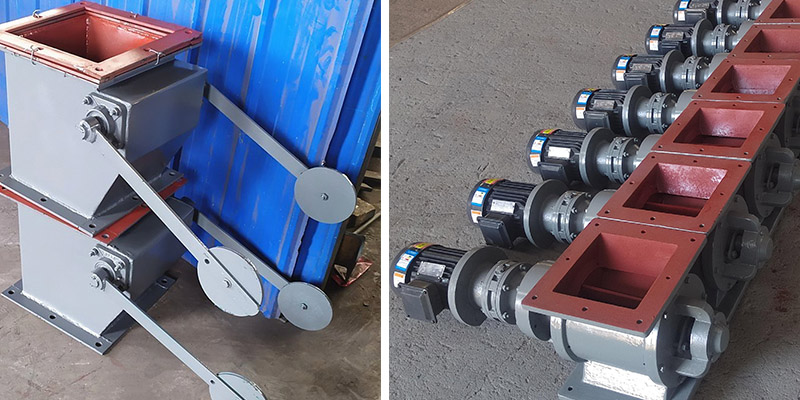
A double flap valve (also called double dump valve or double flap airlock) has two flap plates arranged in series, one above the other. Material accumulates on the upper flap. When the accumulated weight exceeds the counterweight setting, the upper flap opens and material drops into the intermediate chamber. The upper flap then closes and re-seals, and the lower flap opens to discharge the material.
Because the two flaps never open at the same time, there is always at least one sealed barrier between the process and the atmosphere — this is the “air lock.”
Actuation can be weight-only (gravity/counterweight type), pneumatic, or motor-driven. The gravity type has no motors, no sensors, and no electricity — it simply reacts to material weight.
The Working Principle of Rotary Airlock Valve
A rotary airlock valve (also called rotary valve, rotary feeder, or star valve) has a rotating vaned rotor inside a housing. As the rotor turns, pockets between the vanes fill with material at the inlet, rotate to the outlet, and discharge. The vanes maintain a continuous seal against the housing, so air cannot flow backward while material flows through.
The rotor is driven by a geared motor at a controlled speed. Because the rotor turns continuously, the discharge is steady and the rate can be controlled by varying the rotor speed.
3. Side-by-Side Comparison
| Criterion | Double Flap Valve | Rotary Airlock Valve |
| Operating principle | Two flaps open alternately by gravity or actuation | Rotating vaned rotor, continuous |
| Air leakage | Very low at rest; small leakage during flap opening | Continuous low leakage past vane tips |
| Pressure differential | Best up to 0.05-0.1 bar | Handles 0.1-0.5 bar and higher |
| Discharge flow | Batch-wise (trickle discharge) | Continuous, steady |
| Flow rate control | Limited (by flap frequency) | Excellent (by rotor speed) |
| Abrasive material | Good (large clearances, wear plates) | Fair (vane tips and housing wear) |
| Lumpy / odd-shaped material | Good (flap opens wide) | Poor (pockets jam) |
| Sticky / moist material | Good | Poor (pockets clog, rotor sticks) |
| Bridging in hopper above | Moderate risk | Low risk (rotor agitation helps) |
| Power consumption | Near zero (gravity type) | Continuous motor load |
| Moving parts | Few (2 flaps + pivots) | Many (rotor, vanes, seals, gearbox) |
| Maintenance complexity | Low; field-repairable | Higher; needs precision clearances |
| Initial cost | Lower | Higher |
| Typical life of wear parts | Years (flap plates are replaceable) | 1-3 years depending on duty |
| Best applications | Dust collector hoppers, cyclones, intermittent discharge | High-rate continuous discharge, feeding, metering |
4. Decision Framework: Step by Step
Step 1: What is the material?
- Fine, free-flowing powder (cement, raw meal, fly ash, kiln dust) → both work
- Abrasive, lumpy, or odd-shaped (clinker chunks, agglomerated material) → double flap valve
- Sticky or moist (filter cake, hydrated lime) → double flap valve
- Dry powder that must be metered precisely → rotary airlock valve
Step 2: What is the pressure difference across the valve?
- Under 0.05 bar (typical dust collector hopper, atmospheric discharge) → both work; double flap is cheaper
- 05-0.1 bar (mild pneumatic pressure) → double flap with reinforced flaps
- Over 0.1 bar (pneumatic conveying line) → rotary airlock valve— a double flap valve cannot hold this pressure
Step 3: What is the discharge rate?
- Intermittent, low rate (dust collector hopper emptying a few tons per day) → double flap valve
- Continuous, high rate (baghouse under a kiln or mill collecting tons per hour) → rotary airlock valve
Step 4: Do you need flow control or metering?
- Just emptying a hopper → double flap valve
- Feeding a process at a controlled rate (feeding a mill, dosing into a conveying line) → rotary airlock valvewith variable speed drive
Step 5: What is your maintenance capability?
- Simple plant, limited maintenance staff, remote site → double flap valve(few moving parts, easy to repair)
- Well-staffed plant that can manage precision clearances and spare rotors → rotary airlock valve
5. Cement Plant Applications
Dust collector hoppers: double flap valve (most cases)
Most cement plant dust collectors (baghouses, cyclones, cartridge collectors) discharge a few tons per hour at atmospheric pressure. A gravity-type double flap valve handles this perfectly: no motor, no electricity, no sensors, just dependable mechanical operation. This is why double flap valves are the standard on cement plant dust collector hoppers. See our double flap valve product page for the full range.
High-rate baghouse under mill or kiln: rotary airlock valve
A baghouse handling the full kiln or mill exhaust collects tens of tons per hour continuously. The discharge must be steady to avoid hopper overflow, and the valve may see a meaningful pressure difference from the duct system. A rotary airlock valve with a variable speed drive is the right choice here. See our rotary airlock valve product page.
Pneumatic conveying line injection: rotary airlock valve
Injecting material into a pressurized pneumatic conveying line requires holding line pressure (typically 0.1-0.5 bar) while feeding material. Only a rotary airlock valve can do this reliably. A double flap valve would leak air back up the line and lose conveying efficiency.
Preheater / cyclone discharge: double flap valve
In the preheater tower, cyclones discharge hot meal at slight negative or positive pressure. Double flap valves (often counterweight type) are the traditional choice here because they are simple, heat-tolerant, and seal well at low differential pressure. For a deeper look, see our flap valve guide for preheater systems.
6. Common Mistakes to Avoid
- Putting a double flap valve on a pneumatic conveying line.The pressure difference blows the flaps open, leaks air, and destroys conveying efficiency. Use a rotary airlock valve.
- Putting a rotary airlock valve under a hopper discharging abrasive lumps.Clinker chunks jam the rotor pockets and grind the vanes. Use a double flap valve.
- Ignoring the pressure difference.“It’s just a discharge valve” is a costly assumption. Check the actual pressure at the valve before selecting.
- Sizing the valve too small.A rotary airlock valve undersized for the hopper will flood and stall the rotor. Size for peak flow, not average flow.
- Forgetting the safety gate.On large hoppers, install a slide gate or butterfly valve above the discharge valve so it can be isolated for maintenance without emptying the whole hopper.
- No access or maintenance clearance.Both valves need headroom for removal and inspection. Design the hopper support so the valve can be dropped out and replaced.
7. Quick Selection Table for Cement Plant Engineers
| Location | Material | Typical ΔP | Recommended device |
| Dust collector hopper, small | Cement, fly ash, kiln dust | 0-0.02 bar | Double flap valve (gravity) |
| Dust collector hopper, large baghouse | Cement, raw meal | 0-0.05 bar | Double flap valve or rotary airlock valve |
| Mill/baghouse continuous discharge | Cement, fly ash (tens of t/h) | 0-0.1 bar | Rotary airlock valve |
| Pneumatic conveying injection | Cement, raw meal | 0.1-0.5 bar | Rotary airlock valve |
| Preheater cyclone discharge | Hot meal | ±0.02 bar | Double flap valve (counterweight) |
| Clinker / lumpy discharge | Clinker, chunks | 0-0.05 bar | Double flap valve (reinforced) |
| Sticky / moist material | Filter cake, hydrated lime | 0-0.05 bar | Double flap valve (large opening) |
| Metering / dosing to process | Powder, granules | any | Rotary airlock valve (VFD) |
8. FAQ
Q1: What is the main difference between a double flap valve and a rotary airlock valve?
A double flap valve has two flaps that open alternately to discharge material in batches while maintaining an air lock. A rotary airlock valve has a continuously rotating vaned rotor that discharges material steadily. Double flap valves are simpler and cheaper; rotary airlock valves handle higher pressure and continuous duty.
Q2: Which valve is better for a dust collector hopper?
For most cement plant dust collector hoppers (atmospheric pressure, intermittent discharge), the double flap valve is the better and cheaper choice. Use a rotary airlock valve only for high continuous discharge rates or significant pressure difference.
Q3: Can a double flap valve hold pneumatic conveying pressure?
No. Double flap valves are rated for low differential pressure (up to about 0.05-0.1 bar with reinforcement). For pneumatic conveying line injection, use a rotary airlock valve.
Q4: Do double flap valves need electricity?
The gravity (counterweight) type does not — it operates purely on material weight. Pneumatic and motor-driven types need air or power. This is why gravity double flap valves are popular on remote or simple installations.
Q5: How long do rotary airlock valve vanes last?
With abrasive cement dust, vane tips and housing wear significantly in 1-3 years. Use replaceable wear tips and hardened housings to extend life. A double flap valve’s wear plates typically last much longer because there is no continuous rubbing contact.
Q6: Which valve is cheaper?
The double flap valve is cheaper to buy, install, and maintain — especially the gravity type, which has almost no moving parts. Rotary airlock valves cost more but earn it in continuous high-rate service.
Q7: Can I replace a double flap valve with a rotary airlock valve?
Yes, if the application calls for continuous discharge or higher pressure. But check the hopper discharge opening size and support structure first — rotary valves need different mounting and motor access.
Q8: Why does my dust collector blow dust backward?
Usually a leaking or stuck discharge valve. Check that the flaps seat properly and the seals are intact. If the valve is a rotary type, worn vane tips may be leaking air. See our rotary valve troubleshooting guide and double flap valve troubleshooting guide.
9. Summary
The double flap valve and rotary airlock valve are not interchangeable — they are specialized tools.
- Double flap valve: low pressure, intermittent discharge, abrasive or lumpy material, simple maintenance, lowest cost. The standard under most cement plant dust collector hoppers.
- Rotary airlock valve: continuous high-rate discharge, higher pressure, precise feeding and metering. The standard for baghouse main discharge and pneumatic conveying injection.
Answer the five questions in Section 4 — material, pressure, rate, control, and maintenance — and the choice becomes obvious.
If you are selecting a discharge valve for a new dust collector, silo, or conveying line, contact Darko Cement with your material, pressure, and discharge rate. We manufacture both double flap valves and rotary airlock valves and will recommend the right device for your exact duty.