In the family of baghouse dust collectors, the pulse jet bag filter is arguably the most widely used type. Especially in high-concentration dust applications such as metallurgy, building materials, mining, and chemical industry, the pulse jet bag filter has almost become the “standard configuration”. Why is it particularly suitable for handling high-concentration dust? To answer this question, we need to start with its working mechanism and structural characteristics.
I. What is “High-Concentration Dust Condition”?
In industrial sites, high-concentration dust usually means:
-
The dust concentration at the inlet of dusty gas is very high, which may reach tens, hundreds or even thousands of g/Nm³ (the specific value varies by industry);
-
The dust source is powerful, the dust-producing points are concentrated, and the dust volume fluctuates greatly in a short time;
-
The dust particle size distribution is wide, including both coarse particles and a large amount of fine dust.
Such working conditions put forward two core requirements for dust collection equipment:
-
It must be able to withstand high dust loads without being quickly “clogged”;
-
It must be able to maintain the filter bag within an acceptable resistance range through effective cleaning methods for a long time.
The pulse jet bag filter is designed with an efficient working mechanism around these two points.
What is a pulse jet bag filter?
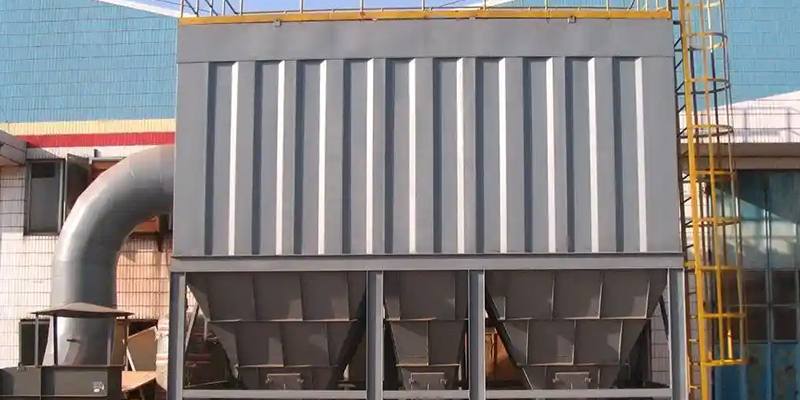
It is a high-efficiency dry dust collection equipment specially designed to cope with high dust loads. Its core advantage is that it can stably withstand the impact of high-concentration dust, and at the same time maintain long-term efficient operation of the equipment through high-efficiency cleaning.
II. Pulse Cleaning Provides Powerful “Regeneration” Capability
The core feature of the pulse jet bag filter is the use of compressed air to perform powerful instantaneous jet cleaning on the filter bags. This is not only the key difference from ordinary baghouse dust collectors, but also the core advantage of adapting to high-concentration dust conditions.
-
During cleaning, the solenoid pulse valve opens, and high-pressure compressed air instantly enters the injection pipe, guided by the venturi tube, forming a high-speed air flow that rushes into the filter bag.
-
This air flow will make the filter bag expand and vibrate briefly, shaking off the dust layer attached to the surface of the filter bag, and making the dust fall into the ash hopper.
How does the pulse jet bag filter work?
Its core lies in this pulse jet cleaning mechanism. Through the cycle of “filtration – cleaning – regeneration”, it achieves continuous and stable dust removal, which is especially suitable for high-concentration scenarios with large dust volume and dense dust layers. This cleaning method has several key advantages:
-
Strong cleaning force, suitable for high-load dust layers In high-concentration working conditions, the dust layer formed on the surface of the filter bag is relatively thick and dense. If the cleaning force is insufficient, it is easy to accumulate thicker and thicker, leading to a sharp increase in resistance. The instantaneous energy of pulse jet is enough to break up the dust layer, maintaining a good “regeneration” capability of the filter bag, which is also one of the core reasons why the pulse jet bag filter is suitable for high-concentration dust.
-
Adjustable cleaning frequency to adapt to working condition changes By adjusting parameters such as injection cycle, injection time, and injection pressure, the cleaning frequency can be flexibly controlled according to changes in dust concentration and resistance. When the dust concentration is high and the resistance rises rapidly, the interval can be appropriately shortened; when the working condition is light, the cleaning frequency is reduced to reduce filter bag fatigue and compressed air consumption, balancing dust removal effect and equipment loss.
-
Compartmentalized offline cleaning to protect filter bags Many large and medium-sized pulse jet bag filters adopt a compartmental structure, which can achieve offline cleaning of a certain compartment, that is, first close the air intake of the compartment, then perform pulse jet cleaning. In this way, the filter bag is no longer scoured by dusty air flow during cleaning, dust is easier to fall off, and mechanical fatigue is reduced, which is conducive to extending the service life of the filter bag and reducing the maintenance cost of pulse jet bag filter.
It is precisely because of this “strong and controllable” cleaning method that the pulse jet bag filter can stably cope with the impact of high-concentration dust for a long time and become the preferred equipment for high-concentration dust collection.
III. Combination of Large Filter Area and Reasonable Filtering Air Velocity
In the face of high-concentration dust, strong cleaning alone is far from enough. It also requires reasonable filtering air velocity and sufficient filter area to jointly ensure system operation, which is also an important feature that makes the pulse jet bag filter superior to other dust collection equipment.
-
Filtering air velocity should not be too high In high-concentration working conditions, if the filtering air velocity is designed too high, it will cause dust to accumulate rapidly on the surface of the filter bag, the resistance will rise rapidly, the cleaning frequency will be forced to increase, and the filter bag will be seriously damaged by fatigue. The pulse jet bag filter usually selects a relatively reasonable filtering air velocity range according to the working conditions, balancing processing capacity and resistance control, and avoiding equipment failures caused by unreasonable air velocity.
-
Expand filter area by increasing the number of filter bags In the design of the pulse jet bag filter, sufficient filter area can be obtained by increasing the number of filter bags and reasonably arranging the length and diameter of the filter bags, so that the load per unit area is in a reasonable level. For working conditions with limited space, high-efficiency filter media can also be used to reduce the required area, realizing “small space, high efficiency” high-concentration dust treatment.
-
Dust layer participates in filtration to improve efficiency In high-concentration working conditions, a stable dust layer is formed on the surface of the filter bag quickly. This dust layer itself also has a good filtering effect, which helps to intercept fine particles. Under a suitable cleaning strategy, the thickness of the dust layer is controlled in the range of “not only ensuring high filtration efficiency, but also not leading to excessive pressure difference”, so that the dust removal efficiency of the pulse jet bag filter is always maintained above 99.99%, meeting the ultra-low emission requirements of enterprises.
Therefore, the pulse jet bag filter forms a dynamic balance through the combination of “large filter area + reasonable air velocity + high-efficiency cleaning”, which is suitable for facing high-concentration dust for a long time, and is also the key reason why it can become the standard configuration in scenarios such as high-concentration dust removal in cement plants and dust removal in mining crushing.
IV. Flexible Structural Form, Easy to Match Various High-Dust Working Conditions
High-concentration dust working conditions are often accompanied by high temperature, strong abrasion, large air volume and other characteristics, which have extremely high requirements on the adaptability of dust collection equipment. The pulse jet bag filter has strong adaptability in structure and can be “customized” to adapt to high-dust scenarios in different industries:
-
It can be designed into different forms such as top air intake, bottom air intake or side air intake, combined with guide plates and pre-separation structures to reduce direct scouring of filter bags by large particles, extend the service life of filter bags, and reduce the maintenance cost of pulse jet bag filter.
-
It can be used in combination with pre-dust removal equipment such as cyclone dust collectors to first remove a part of coarse particles, and then the bag undertakes the fine filtration task, further reducing the filter bag load and adapting to ultra-high concentration dust working conditions. This is also one of the important differences between pulse jet bag filter and ordinary baghouse filter.
-
Different filter media (such as polyester, aramid, PPS, PTFE, etc.) can be selected according to factors such as temperature and corrosion to cope with high temperature, high humidity and corrosive dust environments, expanding the scope of industries applying pulse jet bag filters.
These flexibilities enable the pulse jet bag filter to be “customized” to adapt to typical high-concentration dust occasions such as cement kiln tails, iron and steel blast furnaces, mining crushing and screening, and various powder grinding and packaging.
In specific engineering implementation, professional engineering companies often specially configure the structure, filter media and cleaning system of the pulse jet bag filter according to the dust characteristics and working conditions of each dust-producing point, instead of simply applying the “one-size-fits-all” standard equipment, to ensure that the equipment is fully adapted to the on-site working conditions and exerts the best dust removal effect.
V. Key Design and Operation Points Under High-Concentration Dust Conditions
Of course, “suitable for high-concentration dust working conditions” does not mean that “installing any pulse jet bag filter will definitely work well”. To truly give play to its advantages, achieve long-term stable operation, and reduce failure risks and maintenance costs, several key points need to be paid attention to in design and operation, which are also the core focuses of pulse jet bag filter maintenance:
-
Inlet air flow organization and pre-separation Through reasonable structures such as guide plates and diffusion chambers, the dusty air flow is made as uniform as possible before entering the filter bag area, reducing local scouring and dust concentration. For ultra-high concentration working conditions, a cyclone section or sedimentation chamber can be added to first settle a part of coarse particles, reduce the filter bag load, and extend the service life of the filter bag.
-
Filter media selection and protectionHigh-concentration dust is usually accompanied by abrasiveness. It is necessary to select filter media with good wear resistance, and reduce direct impact by controlling the air flow velocity and direction. If there is high temperature or corrosive gas, corresponding high-temperature and corrosion-resistant filter media must be matched, which is the key for the pulse jet bag filter to adapt to complex high-dust working conditions and also the core of reducing equipment failures.
-
Reasonable cleaning control strategy It is not advisable to simply pursue “the cleaner the better”. Excessive cleaning will accelerate filter bag fatigue; insufficient cleaning will lead to increased pressure difference. It is recommended to adopt differential pressure control or combined differential pressure + timing control, and continuously optimize parameters through actual operation data to achieve a balance between cleaning effect and filter bag life, which is also one of the core skills of how to maintain a pulse jet bag filter.
-
Improved ash hopper ash discharge system Under high-concentration dust working conditions, the dust volume in the ash hopper is large. If the ash discharge is not smooth, it is easy to accumulate dust, bridge, and even “return dust” to the filter bag area, affecting equipment operation. It is necessary to be equipped with reliable ash discharge valves and ash conveying equipment, and consider anti-bridging and anti-caking measures according to dust characteristics to ensure smooth ash discharge and avoid secondary failures.
-
Strengthen daily inspection and maintenance High dust load means that the equipment is in a high-load state for a long time. It is very necessary to regularly inspect components such as pulse valves, air bags, filter bags, skeletons, and box seals to avoid small faults evolving into major accidents. This is also the key to ensuring the long-term stable operation of the pulse jet bag filter and reducing the overall maintenance cost.
VI. Summary: Why Does “High-Concentration Dust” Prefer Pulse Jet Bag Dust Removal?
In summary, the choice of pulse jet bag filter for high-concentration dust working conditions is mainly because it has the following comprehensive advantages, which are also the core reasons why it can become the industry standard:
-
Powerful and adjustable pulse cleaning mechanism, which can effectively cope with thick dust layers, avoid equipment “clogging”, and adapt to the needs of high-concentration dust collection;
-
Through reasonable filtering air velocity and large filter area, stable operation under high load is achieved, balancing dust removal efficiency and equipment life;
-
Flexible structure and various filter media, which can adapt to various high-concentration, high-temperature and high-abrasion dust environments, expanding the application scope;
-
There are a large number of mature application cases in actual engineering, with controllable risks. Whether it is steel mill dust treatment, high-concentration dust removal in cement plants, or mining crushing dust removal, there are rich successful experiences.
Of course, each high-concentration dust project still needs to be carefully designed and repeatedly debugged in combination with specific working conditions, instead of simply applying empirical parameters. Only when the design, installation, commissioning, operation and maintenance links are in place can the pulse jet bag filter truly deserve the title of “the first choice for high-concentration dust working conditions” and provide enterprises with an efficient, stable and long-term dust removal solution.