In the industrial dust collection field, many business owners often face a confusion: “Why is my dust collection equipment experiencing high resistance and failing to clean thoroughly?” As a professional dust collector manufacturer, Nantong Darko has found through years of engineering practice that the problem usually lies not in equipment quality, but in the matching between working conditions and equipment type. Cartridge Dust Collector, as a representative of refined dust collection, outperforms traditional Baghouse Dust Collector in specific “fine, low, dry” working conditions.
1. What is a Cartridge Dust Collector? (Structure and Working Principle)
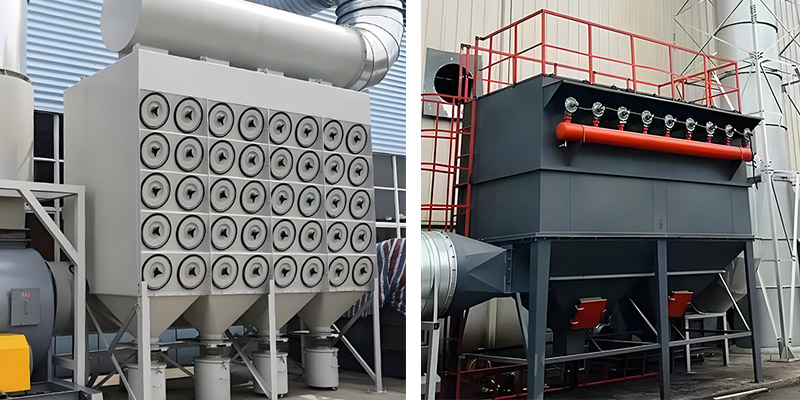
A cartridge dust collector is an efficient dry dust collection equipment. Its core lies in the use of folded filter cartridges as filtering elements, instead of traditional fiber filter bags.
Core Structure:
-
Filtration System: Cylindrical filter cartridges made of polyester fiber, PTFE membrane or anti-static materials, designed for high-efficiency fine dust filtration.
-
Cleaning System: Adopts Pulse Jet cleaning technology, which shakes off dust accumulated on the surface of filter cartridges through instantaneous release of compressed air.
-
Airflow Organization: Including air inlet, ash hopper, clean air chamber and exhaust system, ensuring reasonable airflow distribution for stable operation.
Working Principle of Cartridge Dust Collector:
After dusty gas enters the dust collector through the air inlet, the airflow speed slows down, and large-particle dust naturally settles into the ash hopper. Fine dust is intercepted by the outer wall of the filter cartridge as the airflow passes through, and the purified air is discharged through the inside of the filter cartridge. This working principle ensures high dust collection efficiency even for sub-micron particles.
2. Cartridge vs. Baghouse: Four Core Advantages of Cartridge Dust Collectors
Why are more and more precision processing workshops abandoning baghouse dust collectors and choosing cartridge dust collectors instead? The comparison of core characteristics between the two is as follows, and the advantages are obvious at a glance:
|
Characteristics
|
Cartridge Dust Collector
|
|
|
Filtration Area
|
3-5 times that of baghouse under the same volume, optimizing filtration efficiency
|
Relatively small filtration area
|
|
Equipment Volume
|
Compact structure, saving floor space for industrial workshops
|
Large volume, requiring more installation space
|
|
Filtration Precision
|
High (can capture fine dust above 0.5μm), suitable for fine dust control
|
Medium (mainly targeting particles above 5μm)
|
|
Maintenance Frequency
|
Fast filter cartridge replacement and long maintenance cycle, reducing industrial dust collector maintenance cost
|
Time-consuming and laborious filter bag replacement
|
Combined with the characteristics in the table, the core advantages of cartridge dust collectors can be summarized as: higher filtration efficiency, better space utilization, and more convenient maintenance, especially suitable for working conditions that require high dust collection precision and have limited space.
3. Optimal Application Scenarios: Which Working Conditions Require It?
Cartridge dust collectors are not “universal equipment”, but they are the absolute main choice in the following high-precision and intermittent working conditions for industrial dust removal:
A. Fine Dust and Smoke Control
For dust with small particle size and weak adsorption, the surface membrane technology of the filter cartridge can achieve a purification efficiency of up to 99.9%, ideal for:
-
Laser/plasma cutting smoke
-
Welding fume treatment
-
Metal polishing and grinding dust
-
Spraying/powder coating workshop dust recycling
B. Indoor Point Source Capture with Limited Space
Due to the small size of the filter cartridge, it is very suitable for deployment next to production lines that require on-site dust collection, such as laboratories, electronic manufacturing, and precision machinery processing, solving the problem of limited space for industrial dust collection equipment.
C. Intermittent Production Working Conditions
If your factory’s production rhythm is discontinuous (on and off), the resistance of the cartridge dust collector recovers quickly, and it will not cause serious dust accumulation and caking due to moisture or static electricity during shutdown, unlike baghouse dust collectors. This ensures stabledust collection performance even in intermittent operation.
4. In-depth Technology: Reasonable “Airflow Distribution” is the Key to Service Life
Many manufacturers only focus on filter materials, but ignore airflow distribution, which is also the main reason for early equipment damage.
When designing a cartridge dust collector, it must be ensured that:
-
Uniform wind speed: Avoid local high-speed airflow directly impacting the filter cartridge, which may cause wear and reduce the service life of the filter cartridge.
-
Prevent short-circuit wind: Ensure that all gas must pass through the filter material for filtration, so as to avoid affecting the dust collection efficiency.
-
Bottom or side air inlet logic: Use the self-weight of dust to assist cleaning, reducing the operating resistance of the system and saving energy for industrial dust collector operation.
5. Pitfall Avoidance Guide: Which Working Conditions Are Not Recommended for Cartridge Dust Collectors?
As a responsible supplier, we need to remind you that the following scenarios should be carefully selected or pre-treated to ensure the normal operation of the cartridge dust collector:
-
High humidity and high viscosity dust: It is very easy to cause “filter cartridge clogging” and lead to cleaning failure, affecting dust collection performance.
-
Fibrous dust: Such as long wood chips, which are easy to wrap in the folds of the filter cartridge and cannot be cleaned effectively.
-
Ultra-high temperature flue gas: If the temperature exceeds 130°C, the service life of conventional filter cartridges will be shortened sharply (special high-temperature resistant materials are required for high-temperature industrial dust removal).
Conclusion: Choosing the Right Working Conditions is More Important Than Choosing the Right Brand
A cartridge dust collector is not an “advanced version of a baghouse”, but an optimal technical route for “fine, low, dry” working conditions. The real core lies not in the equipment shell, but in the selection of filter materials, the design of airflow, and the in-depth adaptation to dust characteristics, which directly determines the dust collection efficiency and service life.
If you are not sure which solution is suitable for your factory, welcome to contact Darko. We provide free working condition diagnosis and customized industrial dust collection solution design to help your factory meet ultra-low emission standards.
Frequently Asked Questions (FAQ)
Q1: How often should the filter cartridge of a cartridge dust collector be replaced?
A: Under standard working conditions, the service life of high-quality filter cartridges is usually 12-24 months. If the resistance is consistently higher than 1500Pa, replacement should be considered to maintain stable dust collection efficiency.
Q2: Can cartridge dust collectors handle flammable and explosive dust?
A: Yes. However, anti-static filter materials, explosion vents, and flame arresters must be configured to ensure production safety for industrial dust removal.
Q3: Why is the price of cartridge dust collectors sometimes higher than that of baghouse dust collectors?
A: The unit cost of filter cartridges is relatively high, but considering the saved plant space cost and the environmental protection compliance benefits brought by improved filtration efficiency, its comprehensive return on investment (ROI) is usually higher.