



Polyester Conveyor Belt
- High Modulus, Low Elongation, Stable Conveying
- Impact & Wear Resistant, Longer Service Life
- No Slippage Under Heavy Loads
- For High-Temp Heavy-Duty Conditions
- Full Range Compliant with GB 7984
- Strict Quality Control, Certified Interlayer Adhesion Strength
- Customizable for All Working Conditions
What material are Polyester Conveyor Belts made of?
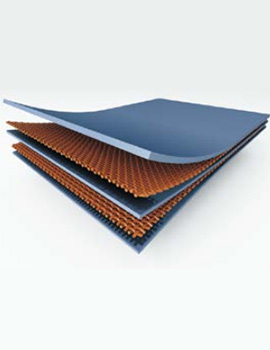
The polyester conveyor belt is mainly composed of three core categories of materials:
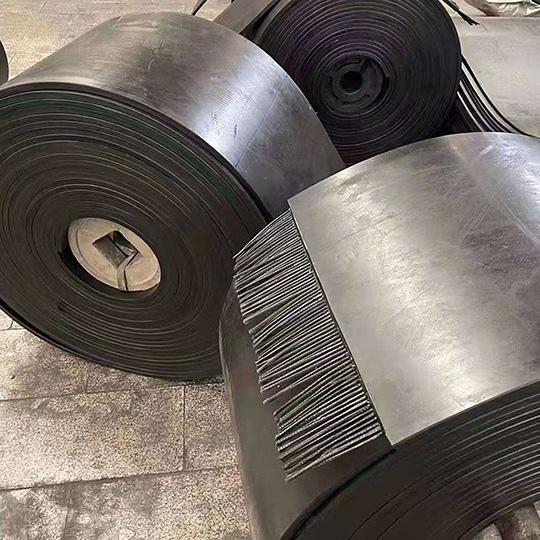
- Skeleton load-bearing material: The core is EP dipped canvas, with polyester fibers in the warp direction and nylon (polyamide) fibers in the weft direction.
- Interlayer bonding material: It includes core rubber and friction rubber, which are mainly made of natural rubber, mixed with an appropriate amount of styrene-butadiene rubber, and compounded with additives such as sulfur, accelerators and reinforcing carbon black, to tightly bond multiple layers of canvas into a whole and ensure the interlayer bonding strength meets the standards.
- Outer covering and protective material: The cover rubber is mainly made of natural rubber, styrene-butadiene rubber and cis-butadiene rubber, mixed with functional additives such as high-wear-resistant carbon black and softener.
- Type of Polyester Conveyor Belt
- EP Belt Size Specs
- Application
| Version | Fabricmaterial | Type | Thickness | Tensilestrength N/mm | |||||
| warp | weft | mm/layer | 2l ayers | 3 layers | 4 layers | 5 layers | 6 layers | ||
| EP conveyor belt | Polyester fiber | nylon fiber | EP100 | 0.9 | 200 | 300 | 400 | 500 | 600 |
| EP125 | 0.9 | 250 | 375 | 500 | 625 | 750 | |||
| EP150 | 1.0 | 300 | 450 | 600 | 750 | 900 | |||
| EP200 | 1.1 | 400 | 600 | 800 | 1000 | 1200 | |||
| EP250 | 1.4 | 500 | 750 | 1000 | 1250 | 1500 | |||
| EP300 | 1.5 | 600 | 900 | 1200 | 1500 | 1800 | |||
| EP350 | 1.7 | — | 1050 | 1400 | 1750 | 2100 | |||
| EP400 | 1.9 | — | — | 1600 | 2000 | 2400 | |||
| EP500 | 2.3 | — | — | 2000 | 2500 | 3000 | |||
| EP630 | 3.0 | — | — | 2520 | 3150 | 3780 | |||
| Version | Fabricmaterial | Type | Cover thickness | Width
mm |
Length
m |
Roll diameter
m |
||
| warp | weft | upper | lower | |||||
| EP conveyor belt | Polyester fiber | nylon fiber | EP100 | 0-20 | 0-10 | 300-3000 | ≤ 500 | ≤ 2.8 |
| EP125 | 0-20 | 0-10 | 300-3000 | ≤ 500 | ≤ 2.8 | |||
| EP150 | 0-20 | 0-10 | 300-3000 | ≤ 500 | ≤ 2.8 | |||
| EP200 | 0-20 | 0-10 | 500-3000 | ≤ 500 | ≤ 2.8 | |||
| EP250 | 2-30 | 1.5-15 | 500-3000 | ≤ 500 | ≤ 2.8 | |||
| EP300 | 2-30 | 1.5-15 | 500-3000 | ≤ 500 | ≤ 2.8 | |||
| EP350 | 2-30 | 1.5-15 | 500-3000 | ≤ 500 | ≤ 2.8 | |||
| EP400 | 4.5-30 | 1.5-15 | 800-3000 | ≤ 500 | ≤ 2.8 | |||
| EP500 | 4.5-30 | 2.0-15 | 800-3000 | ≤ 500 | ≤ 2.8 | |||
| EP630 | 4.5-30 | 2.0—15 | 800-3000 | ≤ 500 | ≤ 2.8 | |||
Darko EP polyester rubber conveyor belts are widely used for bulk material conveying:
- Mining & quarry, crushed stone, aggregate
- Cement plant, coal handling
- Port bulk cargo loading & unloading
- Metallurgy, power station
- Sand, gravel and mineral transportation
How Long Is The Service Life Of Polyester Conveyor Belt?
Under normal light-load working conditions (such as grain processing and light bulk material conveying): the polyester conveyor belt service life can reach 5-8 years, and it can be further extended in some low-wear scenarios.
Under conventional heavy-load working conditions (such as coal, cement and ore transportation): the polyester conveyor belt service life is usually 3-5 years.
Under high-wear/strong-corrosion working conditions (such as conveying sharp ores, high-temperature sinter and corrosive materials): the polyester conveyor belt service life is mostly 2-3 years, and some specially customized models can be close to 4 years.
The difference between Polyester Conveyor Belt and Nylon (NN) Conveyor Belt
| Item | Polyester Conveyor Belt | Nylon (NN) Conveyor Belts |
| Breaking Elongation | ≤2% | 15%~25% |
| Limited Temperature | 120℃ | 80℃ |
| Acid and alkali resistance | Good | Moderate |
| Strength retention rate in humid environment | The strength significantly decreases after absorbing moisture. | Even at a moisture content of 20%, it still retains over 70% of its original strength. |
| Applicable scenario | Long-distance horizontal transportation, high-temperature conditions, transportation of acidic materials | High drop impact conveying, underground high humidity operations, small radius curve climbing conveying |
Related Products
FAQ About Polyester Conveyor Belt
Based on your operating conditions, we recommend the EP200 model with a 4-layer polyester canvas frame, covered with 6mm top rubber and 3mm bottom rubber for wear resistance. This type of polyester conveyor belt can meet the heavy-load conveying demand of 200 tons per hour, without causing performance redundancy. The overall procurement cost is about 30% lower than that of higher models, and its service life can reach more than 3 years.
Yes. We can customize food-grade polyester conveyor belts. The covering rubber is made of natural rubber that complies with food contact safety standards. It has no odor, does not contaminate the materials, has a smooth surface without residues, is easy to clean and disinfect, and is fully suitable for bulk material transportation scenarios in the food processing and food baking industries.
For regular polyester conveyor belts, a 1-year free warranty is provided. For special customized models, a 6-month warranty is offered. During the warranty period, if there are non-human-induced quality issues, we will provide free technical support and maintenance services. Even if it is not a conveyor belt of our brand, as long as it is within our production service scope, we can also provide full-process technical support, truly achieving comprehensive after-sales guarantee throughout the entire period.
Under normal bulk material conveying conditions without strong sharp material impacts, the normal service life of polyester conveyor belt can reach 3 to 5 years; in heavy-load and high-wear conditions, using a high-maintenance-resistant coating formula can also ensure stable operation for more than 2 years, which is much better than ordinary cotton canvas conveyor belts of the same specification.