Introduction
A ball mill is the heaviest rotating equipment in a cement plant. A typical mill shell weighs hundreds of tonnes, carries 30-40% of its volume in grinding media, and runs 24 hours a day. When it stops, the entire grinding line stops — and when it fails suddenly, the repair bill is measured in weeks of downtime and six figures.
The good news is that ball mill failures are almost never sudden. They announce themselves: liner bolts working loose, gear teeth showing wear, bearing temperatures creeping up, grinding media consumption rising. Each sign appears weeks before failure. A systematic maintenance routine — daily checks, weekly inspections, quarterly measurements, annual overhauls — catches them all.
This guide is the practical ball mill maintenance program: what to check, how often, what the numbers mean, and when to act. It covers liners, grinding media, the drive train, bearings and hollow shafts, lubrication, and the early warning signs to watch.
1. What Is a Ball Mill
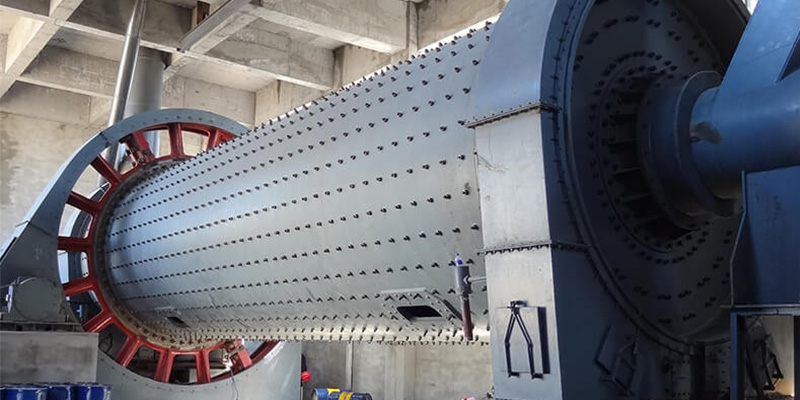
A ball mill is a horizontal rotating cylinder filled with grinding media — steel balls or cylpebs — that crushes and grinds material as the shell turns. It is the classic workhorse of cement clinker grinding, raw meal grinding, and mineral processing, and it is also used for fine grinding of coal, slag, and other materials in cement plants.
How Does It Work?
The working principle is simple: the shell rotates around its horizontal axis at a speed that carries the grinding media up the inner wall until gravity pulls them back down in a cascade. The falling media impact and crush the material, while the rolling and tumbling action between the media and the liner grinds it finer. The fineness of the product is controlled by the shell speed, the size and charge of the grinding media, the feed rate, and the classifier at the mill outlet.
Because the ball mill works through continuous impact and abrasion, the parts that fail are predictable — liners, grinding media, gears, and bearings all wear from this constant motion. That is exactly why a maintenance routine matters: the working principle tells you what will wear, and the maintenance schedule tells you when to catch it. The rest of this guide covers both. If you are new to the machine itself, our ball mill page explains the design in detail.
2. How Ball Mills Fail: The Failure Sequence
Understand the sequence and the maintenance routine becomes obvious:
- Liner wear and bolt loosening.Liners wear thin and their fixing bolts work loose under impact. A loose liner shifts, cracks, and can detach — a detached liner is a catastrophic event that damages the shell.
- Grinding media consumption rises.Steel balls and cylpebs wear down; the charge loses its correct size distribution, grinding efficiency drops, and power draw changes.
- Drive train wear.The girth gear and pinion wear together; incorrect backlash and bad lubrication accelerate tooth damage.
- Bearing and hollow shaft stress.The trunnion bearings carry the full mill weight; rising temperature signals lubrication failure or misalignment.
- Final failure.Gear tooth fracture, bearing seizure, or shell damage — all preceded by warning signs.
Every step after the first is preventable with the routine below.
3. Maintenance Schedule Overview
| Frequency | Check | Who |
| Daily (operating) | Bearing temperatures, gear lubrication, unusual noise or vibration, motor current | Operator |
| Weekly | Liner bolt tightness (spot check), media level indicator, gear mesh condition, oil levels | Operator / maintenance |
| Monthly | Liner thickness measurement at wear points, gear tooth condition, coupling alignment check, lubrication system inspection | Maintenance |
| Quarterly | Full liner inspection and bolt re-torque, media charge assessment (add grinding media), gear backlash measurement, vibration measurement on bearings | Maintenance + engineer |
| Annually | Mill internal inspection (shell, liners, feed/discharge), full gear inspection, bearing inspection and alignment, oil analysis, planned overhaul plan | Maintenance + engineer |
| Every 3-5 years | Major overhaul: relining, gear inspection or replacement, bearing reconditioning, shell inspection | Engineer + external specialists |
4. Liners: The First Line of Defense
Liners protect the shell and drive the grinding action. Their failure mode is specific: thinning from wear, then bolt loosening, then shifting, cracking, and detachment.
What to check
- Liner thickness— measure monthly at known wear points (the feed end wears faster). Know your liner’s minimum safe thickness from the supplier.
- Bolt tightness— spot-check weekly, full re-torque quarterly. Loose bolts are the number one early warning of a liner about to move.
- Cracks and deformation— visual check during quarterly inspections. A cracked liner must be replaced before it detaches.
- Liner type— rubber liners for fine grinding and low noise; steel liners for coarse/abrasive duty. Match the liner to the application.
When to act
- Bolt keeps loosening after re-torque → check for liner movement underneath
- Thickness below minimum → plan replacement at next scheduled stop
- Any crack → replace immediately at the next stop; do not run a cracked liner
5. Grinding Media: Charge Management
The media charge does the actual grinding. It wears continuously, and a degraded charge silently destroys efficiency.
What to check
- Media consumption— track kg per tonne of product. A rising trend signals an issue (wrong media quality, wrong charge, liner problem).
- Charge level— check the media level indicator against the design level; add media before it drops too far.
- Size distribution— balls wear down unevenly. Periodic re-balling (adding large balls) restores the correct distribution; a full charge assessment (empty and screen the mill) every 1-2 years gives the complete picture.
- Media quality— hardness and microstructure determine consumption. Cheap media costs more in the long run.
Typical media consumption
- Cement grinding: roughly 100-500 g of grinding media per tonne of cement, depending on clinker grindability and mill condition. Track your own baseline and watch for change.
6. Drive Train: Girth Gear, Pinion, and Gearbox
The drive train transfers power from the motor to the shell. Gear damage is expensive and slow to repair — it must be caught early.
What to check
- Gear lubrication— spray or bath lubrication working correctly, oil quality, contamination.
- Tooth condition— pitting, scuffing, wear steps on the working flank. Monthly visual check, quarterly detailed inspection.
- Backlash— measure quarterly. Correct backlash is set by the manufacturer (typically 0.5-1.5 mm for large mill gears); too tight or too loose accelerates wear.
- Pinion— wears faster than the girth gear (smaller diameter, more tooth contacts). Pinion replacement is routine; gear replacement is a major event.
- Couplings and gearbox— alignment, oil levels, unusual noise.
When to act
- Pitting spreads or deepens → investigate lubrication and load; plan reconditioning
- Backlash outside range → adjust before further wear
- Any tooth fracture → stop immediately; inspect the whole gear
7. Bearings and Hollow Shafts
The trunnion bearings carry the entire mill. Bearing failure is the most common cause of unplanned mill stops.
What to check
- Bearing temperature— monitor daily. A sustained rise of 10-15°C above normal is a warning; most mills alarm at 65-75°C.
- Vibration— quarterly baseline measurement; a rising trend at the bearing indicates wear or misalignment.
- Lubrication— oil level, oil quality, flow to the bearing. Oil analysis (sampled annually) catches contamination and wear metals early.
- Hollow shaft / trunnion surface— inspect for scoring and wear steps at each major service.
When to act
- Temperature rises and stays up → check lubrication first; then alignment; then bearing condition
- Vibration trend rising → investigate before bearing damage advances
- Oil analysis shows elevated wear metals → schedule bearing inspection
8. Lubrication System
Nearly every “unexpected” ball mill failure traces back to lubrication.
| System | Check frequency | What to verify |
| Trunnion bearing oil system | Daily | Oil flow, pressure, temperature, cleanliness |
| Girth gear lubrication | Daily / weekly | Spray function, oil film on teeth |
| Gearbox oil | Monthly | Level, quality; change per schedule |
| Grease points (feeders, auxiliary drives) | Weekly | Grease per schedule; avoid over-greasing |
Keep oil analysis on an annual cycle — it is the cheapest insurance you can buy for a mill.
9. Early Warning Signs: When to Act
| Sign | Likely cause | Action |
| Bearing temperature rising | Lubrication failure, misalignment, bearing wear | Check oil; check alignment; inspect bearing |
| Liner bolts loosening repeatedly | Liner movement underneath | Re-torque; if repeated, inspect liner and replace |
| Falling mill output | Media charge degraded, liner wear, feed issue | Check charge level; add media; inspect liners |
| Rising power draw | Media overcharge, wrong feed, mechanical drag | Check charge; check for mechanical issues |
| Gear noise / knocking | Backlash wrong, tooth damage, lubrication failure | Stop; inspect gear mesh and teeth |
| Vibration trend rising | Bearing wear, coupling misalignment, foundation | Measure and trend; schedule inspection |
| Oil contamination | Seal wear, water ingress, overdue change | Oil analysis; change; find the source |
10. Ball Mill Maintenance Checklist (Printable)
Daily
- Bearing temperatures normal
- Gear lubrication running, oil film visible
- No unusual noise or vibration
- Motor current normal
Weekly
- Liner bolt tightness spot check
- Media level indicator checked
- Oil levels checked (bearings, gearbox)
- Gear tooth condition visual check
Monthly
- Liner thickness measured at wear points
- Gear lubrication system inspected
- Coupling alignment spot check
- Lubrication filter condition checked
Quarterly
- Full liner inspection; bolts re-torqued
- Media charge assessed; grinding media added as needed
- Gear backlash measured
- Bearing vibration measured and recorded
Annually
- Mill internal inspection (shell, liners, feed/discharge)
- Full gear inspection
- Bearing inspection and alignment
- Oil analysis performed
- Overhaul plan updated
11. FAQ
Q1: How often should a ball mill be serviced?
Daily operator checks (bearings, lubrication, noise), weekly liner bolt and media checks, quarterly liner thickness and gear backlash measurements, annual full inspection, and a major overhaul every 3-5 years.
Q2: How long do ball mill liners last?
Typically 6,000-12,000 operating hours for steel liners in cement duty, depending on feed abrasiveness; rubber liners can last longer in fine grinding. Measure thickness monthly and replace before the minimum safe thickness.
Q3: How often should grinding media be added?
Add media when the charge level drops below the design level — typically every few hundred operating hours depending on consumption. Track consumption per tonne of product and re-ball on that baseline.
Q4: Why is my ball mill output falling?
Usually one of three: the media charge is degraded (need re-balling or re-screening), liners are worn and losing lifting action, or the feed system has an issue. Check charge level first — it is the fastest fix.
Q5: What causes ball mill bearing failures?
Lubrication failure, misalignment, contamination, and fatigue. Most are preventable: monitor temperature and vibration, keep oil analysis on an annual cycle, and maintain alignment.
Q6: What is the correct backlash for a ball mill girth gear?
Typically 0.5-1.5 mm for large cement mill gears, per the manufacturer’s specification. Measure quarterly; adjust if outside range — incorrect backlash accelerates tooth wear.
Q7: How do I know if my grinding media is the right size?
The charge should have a size distribution matched to the feed: larger balls for coarse feed, smaller media for fine grinding. A periodic full charge assessment (empty and screen) shows whether re-distribution is needed.
Q8: How long does a ball mill last?
With proper maintenance, a ball mill shell lasts 20-30 years or more; liners, grinding media, pinions, and bearings are consumables replaced on their own schedules. Maintenance, not the mill itself, determines life.
12. Summary
Ball mill maintenance is a routine, not a repair:
- Check liners— thickness monthly, bolt tightness weekly, replace before detachment
- Manage media— track consumption, re-ball on a baseline, full assessment every 1-2 years
- Protect the drive train— lubrication, backlash quarterly, catch tooth damage early
- Watch the bearings— temperature daily, vibration quarterly, oil analysis annually
- Write it down— trends matter more than single readings
A mill on this routine runs at design output for decades. The cost is a few hours a week — the cost of failure is weeks of downtime.
If you are planning a new grinding line or upgrading an existing ball mill — or if you need liners, grinding media, or a replacement mill — contact Darko Cement. We manufacture ball mills for cement and mineral grinding, and our engineers will help you match the mill, liners, and media to your material. New to the choice? Start with our vertical or ball mill selection guide.