Introduction
Choosing the right vertical roller mill (VRM) for a new cement grinding line or a ball mill replacement comes down to five numbers: required throughput (t/h), target fineness (cm²/g), feed moisture (%), available power (kW), and plant footprint. Get these five parameters right, and the mill will run at design efficiency for 15+ years. Get them wrong, and you will spend that life cycle fighting oversize feed, product inconsistency, and excessive wear parts.
This guide walks process engineers and procurement managers through the VRM selection process — from defining grinding requirements to comparing vendor proposals. For a deeper technical background, also see our overview of vertical roller mill technology and our separate VRM vs ball mill comparison guide.
What Is a VRM and How Does It Work?
If you are new to vertical milling, here is the short version before the selection details begin.
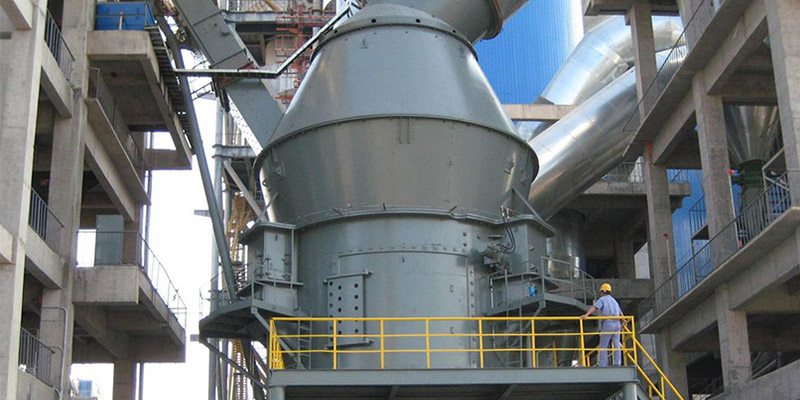
What is a vertical roller mill? A vertical roller mill (VRM) — also called a vertical mill or roller mill — is an industrial grinding machine that reduces hard, abrasive materials (cement clinker, limestone, slag, coal) into fine powder using a rotating horizontal grinding table and 2-4 spring-loaded grinding rollers pressed down onto the table.
What is VRM in a cement plant? In a cement plant, a VRM is the heart of the grinding circuit. It grinds raw meal, cement finish product, or pulverized coal, replacing the older ball mill technology that dominated cement plants through the 20th century.
What is the purpose of a roller mill? Its purpose is twofold: (1) grind material to a target particle size (Blaine fineness) efficiently, and (2) simultaneously dry moist feed using hot kiln exhaust gas, all in a single enclosed machine.
How does a vertical roller mill work? Material is fed onto the center of a rotating table. Centrifugal force spreads it outward into a thin bed under the rollers, which crush it by hydraulic pressure. Upward airflow through the table carries the ground material upward to a dynamic separator; fines pass through to the product collection system, while oversize particles fall back onto the table for another pass. A single machine combines grinding, drying, and classification — which is why it uses 30-40% less energy than a ball mill circuit for the same output.
With that background, the rest of this guide focuses on the numbers and decisions that go into buying the right VRM for your plant.
1. Define Your Grinding Duty First
Before asking any vendor for a quote, lock down the grinding duty on a one-page spec sheet. The following five inputs drive every downstream VRM decision.
1.1 Material being ground
- Clinker + gypsum (ordinary Portland cement):Standard duty. Most VRMs are sized for this.
- Slag (GGBS):More abrasive, lower abrasion index than clinker but higher moisture demand; require higher classifier speeds and wear-resistant table liners.
- Limestone raw meal:Lower fineness requirement (typically 350 cm²/g), higher throughput per kW.
- Pulverized coal / petcoke:Different table geometry, requires inert gas system and explosion protection.
- Fly ash / pozzolana:Lower hardness but higher moisture, impacts drying capacity.
Mixes (e.g., clinker + slag + fly ash) need the mill rated for the hardest and wettest component in the feed, not the average.
1.2 Required throughput and product fineness
These two parameters together set the mill size. A VRM that does 180 t/h at 3500 cm²/g cannot simply be turned up to 180 t/h at 4500 cm²/g — finer grinding reduces capacity by 15-25% on the same mill.
| Product type | Typical fineness (Blaine) | Relative capacity per mill size |
| Ordinary Portland cement | 3300-3800 cm²/g | 100% (baseline) |
| High early strength (53 grade) | 4200-4800 cm²/g | 70-80% |
| GGBS slag cement | 4000-5000 cm²/g | 65-75% |
| Raw meal | 3200-3600 cm²/g | 110-120% |
| Pulverized coal | 15-20% retained on 90 µm | 90-100% |
1.3 Feed moisture
Feed moisture above 6-8% significantly reduces VRM throughput because the mill must spend heat energy drying rather than grinding. Standard VRMs handle up to 8% feed moisture using waste gas from the kiln. If your feed moisture exceeds 10%, you need:
- A larger hot gas supply (kiln exhaust + preheater gas), or
- A separate dressing dryer upstream, or
- A mill with a larger drying chamber.
1.4 Available power and electrical supply
VRM motors run from 250 kW (small mill) to over 6000 kW (large finish mill). Confirm:
- Available transformer capacity
- Starting method (soft starter, VFD, or slip ring)
- Whether your plant wants variable speed (recommended for flexibility across cement grades)
1.5 Plant footprint and headroom
A VRM requires substantially less floor area than a ball mill of equivalent capacity, but it needs significant headroom (typically 12-18 m floor-to-ceiling) for the separator, ductwork, and service platform. Measure your available bay height before specifying.
2. Match Mill Size to Duty — A Quick Sizing Reference
Use the table below as a starting point. Vendor proposals will refine this based on bond work index and actual material abrasiveness.
| Mill table diameter | Motor power | Approx. cement output at 3500 cm²/g | Typical application |
| 1.5-2.0 m | 250-500 kW | 20-40 t/h | Small grinding station, slag finish |
| 2.5-3.0 m | 800-1500 kW | 60-110 t/h | Medium grinding station |
| 3.5-4.0 m | 2000-3500 kW | 130-200 t/h | Full clinker line |
| 4.5-5.5 m | 4000-6000 kW | 220-320 t/h | Large modern cement plant |
| 5.5+ m | 6000+ kW | 350+ t/h | Mega plant / custom |
These are planning numbers only. Final sizing requires a Bond work index test and feed particle size distribution from your actual quarry or clinker.
3. Component-Level Checklist: What to Specify
When comparing vendor proposals, do not only compare headline capacity and price. The following component choices determine 10 years of maintenance cost.
3.1 Grinding table and rollers
- Table material:Ni-hard IV or high chromium cast iron for clinker; consider ceramic overlays for slag.
- Roller number:3-roller mills are simpler; 4-roller mills distribute load better for high-throughput applications.
- Hydraulic tensioning:Specify active roller lifting for maintenance (no need to manually remove rollers).
- Wear life on tires:Ask for guaranteed tire life in hours (typical: 8000-12000 hours for clinker duty).
3.2 Separator
- Static (low efficiency) vs dynamic (high efficiency) separator:For cement finish grinding, a dynamic high-efficiency separator is standard. Static separators are acceptable only for raw meal or coal.
- Adjustable speed via VFD:Required if you switch between cement grades.
- Reject loop design:Oversize particles should return to the table quickly without over-grinding fines.
3.3 Drive system
- Gearbox:A vertical roller mill places enormous axial load on the gearbox. Specify a reputable OEM gearbox (e.g., Flender, Hansen, or equivalent) — this is not the place to save money.
- Motor type:High-efficiency IE3/IE4 motor; VFD drive recommended for energy savings.
- Auxiliary drive:Useful for slow turning during maintenance and startup.
3.4 Process gas system
- Fan sizing:The mill fan handles both grinding air and drying air. Under-sizing the fan is a common cause of low throughput.
- Cyclone bag filter / baghouse:Fine product collection after the separator requires a high-efficiency dust collector. See our pulse jet dust collector selection guide for matching.
- Airlock at mill outlet:A rotary airlock valve or double flap valve prevents air leakage at the product discharge.
3.5 Auxiliary equipment
- Feed belt feederwith weighfeeder for accurate dosing
- Magnetic separatorahead of the mill to remove tramp metal
- Hopper and silofor feed storage (see our cement silo selection guide)
- Discharge chuteto convey ground product to the elevator or air slide
- [Air slide conveyor](https://darkocement.com/air-slide-conveyor/)from mill outlet to blending silo — more energy-efficient than bucket elevator for this service
4. Compare Total Cost of Ownership, Not Just Purchase Price
A VRM that looks 15% cheaper on the quote can cost more over 10 years. Ask each vendor for a 10-year TCO breakdown:
| Cost item | Ask the vendor for |
| Power consumption | kWh/t at your design fineness |
| Wear parts consumption | kg of grinding media per ton of cement |
| Table tire / roller life | Hours before replacement |
| Gearbox life | Years under warranty |
| Dust collector filter bag life | Months in your gas composition |
| Spare parts availability | Local warehouse or factory shipment lead time |
| Warranty terms | Years, and what is excluded |
A typical well-operated VRM uses 28-35 kWh/t for cement finish grinding, versus 45-55 kWh/t for a ball mill system. This 15-25 kWh/t savings is the main financial justification for choosing a VRM in the first place. Make sure the vendor’s claimed energy number is realistic, not marketing.
5. Installation and Commissioning: Things Engineers Forget
- Foundation design:VRM vibration is transmitted into the foundation. The foundation must be engineered for both static load and dynamic vibration amplitude. Do not reuse a ball mill foundation for a VRM without recalculation.
- Cable and duct routing:Plan the main motor cable, hydraulic hoses, and gas ducts before the civil works are poured.
- Commissioning schedule:Allow 4-8 weeks for dry running, then gradual material loading. Do not push to 100% capacity in week one.
- Operator training:VRM operation is more nuanced than a ball mill. Budget for 1-2 weeks of vendor on-site training.
- Spare parts stocking:Pre-order at least one set of table tires and roller sleeves. Air freight for wear parts in an emergency costs more than the parts themselves.
6. FAQ
Q1: What capacity vertical roller mill do I need for a 5000 t/day cement line?
A 5000 t/day clinker line produces roughly 150-180 t/h of cement finish grinding. A VRM with 3.5-4.0 m table diameter and 2500-3500 kW motor is typical. Confirm with a vendor based on your actual clinker work index.
Q2: Can I retrofit a VRM to replace an existing ball mill?
Yes. Many plants retrofit VRM capacity to debottleneck a ball mill circuit. The main constraints are available headroom, foundation suitability, and integration with existing conveying and dust collection. See our complete cement grinding system guide for layout considerations.
Q3: What is the typical wear life of VRM grinding tires?
For ordinary Portland cement clinker, expect 8,000-12,000 hours on Ni-hard IV tires. Slag and abrasive mixes reduce life to 5,000-8,000 hours. Higher chromium or ceramic overlay materials extend life at higher capital cost.
Q4: Do I need a VFD on the VRM main drive?
A VFD is strongly recommended if you produce multiple cement grades or switch between raw meal and finish grinding. It lets you adjust mill speed and separator speed to optimize fineness without changing mechanical settings. For a single-grade dedicated mill, a fixed speed drive can save initial cost.
Q5: How does a VRM compare to a ball mill on energy?
A VRM typically uses 28-35 kWh/t for cement finish grinding; a ball mill system uses 45-55 kWh/t. The VRM also produces more consistent product and has a smaller footprint, but it has higher capital cost and more complex maintenance. Read our dedicated VRM vs ball mill selection guide for a full seven-factor comparison.
Q6: What dust collector do I need after a VRM?
The mill vent gas carries product fines and must go through a pulse jet bag filter or electrostatic precipitator. Size the collector for the mill gas volume (typically 0.8-1.2 Nm³/kg of clinker). Darko’s LMC series pulse jet dust collectors are commonly paired with VRMs in 200-500 t/h cement grinding lines.
Summary
Selecting a vertical roller mill is not a one-number decision. Start from the five key parameters — throughput, fineness, feed moisture, power, and footprint — then evaluate vendors on component quality, energy consumption, wear-part life, and total cost of ownership over 10 years. The cheapest proposal rarely wins on TCO; the proposal that guarantees realistic kWh/t and wear life usually does.
If you are specifying a new VRM or retrofitting an existing ball mill circuit, contact Darko Cement with your grinding duty. Our engineering team can help size the mill and recommend the matching dust collection, air slide, and airlock equipment.