In the entire dust collection system, filter bags filter dust, and the ash cleaning system restores the air permeability of filter bags. The fan drives gas flow and ensures the normal operation of the system. As a key equipment for industrial dust control and waste gas purification, the rationality of dust collection fan selection and the stability of its operation directly determine the treatment efficiency, energy consumption cost and environmental protection compliance rate of the dust collection system. Many on-site faults seem to be caused by filter bag blockage and poor exhaust. In fact, they stem from improper fan selection or abnormal operation status. Even if the system structure is well-designed, it cannot operate stably and efficiently if the fan parameters do not match the actual needs.
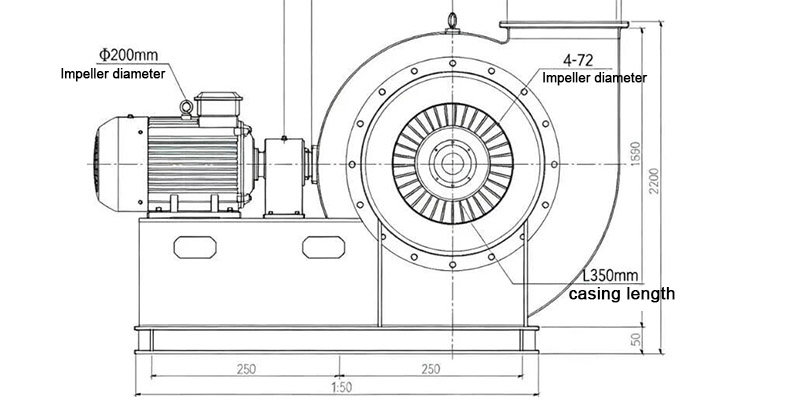
1. Core Functions of Fans in Dust Collection Systems
Fans are the core power equipment of dust collection systems. Their operation status directly affects dust collection efficiency, waste gas purification effect and system energy consumption. Their core functions can be summarized into three points, all of which are indispensable and also the core basis for industrial dust collection fan selection:
-
Provide system negative pressure to form gas flow power and support dust collection and waste gas transportation;
-
Overcome various resistances such as pipeline along-way resistance, dust collector body resistance and elbow loss to ensure the smooth circulation of dust-containing gas and avoid dust deposition and blockage;
-
Maintain stable system air volume to ensure the effective capture of dust by the suction hood, prevent dust leakage and ensure the compliance of the workshop environment.
Simply put: Without sufficient air volume, the suction hood cannot capture dust effectively. This easily leads to dust accumulation in the workshop and unqualified environmental emissions. Without sufficient air pressure, gas cannot overcome system resistance. The entire dust collection system will stop, increasing equipment loss and operation and maintenance costs.
2. Core Parameters for Dust Collection Fan Selection
The core of dust collection fan selection is “accurate matching of working conditions”, not blindly pursuing higher parameters. The following 3 core parameters + 1 auxiliary parameter are the most searched selection-related contents on Google. They are also the key to avoiding selection mistakes and cover all selection scenarios.
1. Air Volume
Air volume is the primary parameter for fan selection, measured in m³/h. It must match the on-site process dust production, the number of workstations and the dust diffusion range accurately. Avoid the misunderstanding of “too large or too small air volume”, which is also the most common selection pain point in industrial dust collection on site.
-
Insufficient air volume: The suction hood has insufficient suction and cannot collect dust effectively. This easily causes dust to spread in the workshop and leads to unqualified environmental emissions. Especially for fine particles such as PM2.5, insufficient air volume will cause serious dust escape and increase the risk of environmental penalties;
-
Excessive air volume: It will not only greatly increase power consumption, but also accelerate filter bag wear, shorten filter bag service life and increase operation and maintenance costs. At the same time, it may lead to excessive load on the ash cleaning system and cause incomplete ash cleaning.
During design and selection, comprehensive calculation should be carried out according to the number of workstations, dust diffusion range, pipeline length, pipe diameter and other factors. At the same time, a 10%-15% safety margin should be reserved to cope with sudden situations such as process fluctuations and pipeline air leakage. Common calculation methods include the space volume method and the suction point air volume method. The core formula of the space volume method is Q=V×n. In industrial scenarios, the ventilation frequency for low-concentration dust is 10-15 times/h, and for high-concentration dust is 25-30 times/h. The formula of the suction point air volume method is Q=3600×A×v to ensure effective dust capture.
2. Air Pressure
The core function of air pressure is to overcome the total system resistance, measured in Pa. Its selection must fully cover various resistance losses. This is also the core pain point of many enterprises’ selection mistakes – ignoring system resistance calculation, resulting in insufficient fan air pressure and abnormal system operation.
The resistance losses to be covered include pipeline along-way resistance, dust collector body resistance, pipeline elbow loss, height difference loss between equipment and pipeline. At the same time, the resistance fluctuation caused by pipeline air leakage and filter bag blockage should be considered. Practical experience shows that the total system resistance is often 10%-15% higher than the theoretical calculation value. This is because there are inevitably problems such as loose interfaces and deviated pipeline direction during on-site pipeline construction. Therefore, a 20% safety margin should be reserved for air pressure during selection to avoid abnormal fan operation and increased energy consumption caused by excessive resistance.
3. Speed and Power
Speed is positively correlated with air volume. The higher the speed, the larger the fan output air volume. But at the same time, energy consumption also increases synchronously. Excessively high speed will accelerate impeller wear and shorten fan service life.
Power selection should be comprehensively calculated according to air volume and air pressure. It should not only leave a certain margin, but also not be too large to avoid energy waste of “using a large motor for small work”. For example, a standard 11KW fan is suitable for 4600m³/h conventional dust treatment. When the filtering area reaches 576m² and the treatment air volume is 30000m³/h, it needs to be upgraded to a 37KW model. Insufficient power will cause motor overload and burnout, while excessive power will increase power consumption by several hundred degrees per month.
4. Material Selection
Material selection directly determines the service life and adaptability of the fan. Especially in industrial scenarios with high temperature, high corrosion and high dust concentration, improper material selection will lead to rapid wear and corrosion of the fan impeller and greatly increase operation and maintenance costs.
-
Normal working conditions: Ordinary carbon steel material is selected for its high cost performance and ability to meet basic dust collection needs;
-
High temperature working conditions: High temperature resistant materials such as 16Mn steel and 304 stainless steel are selected. If the temperature exceeds 280℃, 316L stainless steel is recommended to avoid high temperature deformation and corrosion of the impeller;
-
Corrosive working conditions: Anti-corrosion materials such as FRP and PP materials are selected, or carbon steel fans are subjected to anti-corrosion spraying treatment. For coastal projects, marine-grade epoxy coating should be selected with a salt spray test time of more than 3000 hours;
-
High wear working conditions: Wear-resistant materials are selected, or the impeller is subjected to tungsten carbide spraying treatment. This can reduce the impeller wear by 62% and extend the service life from 1.5 years to 4 years.
3. Common Types and Scene Adaptation of Dust Collection Fans
Different types of dust collection fans are suitable for different scenarios. During selection, they should be selected according to process conditions and on-site conditions. This is a highly searched topic on Google. Many enterprises have low operation efficiency and high energy consumption due to wrong fan type selection.
1. Centrifugal Dust Collection Fan
Core characteristics: High air pressure, stable air volume, strong resistance to dust wear. It is suitable for most industrial dust collection scenarios, especially systems with long pipelines and high resistance (such as mining, metallurgy and building materials industries). It is also the most widely used fan type in industrial dust collection.
Selection points: According to system resistance and air volume, select forward or backward inclined blades. For high dust concentration working conditions, backward inclined blades are preferred. Their wear resistance is more than 3 times that of forward inclined blades, and the impeller life can be extended to 36000 hours in actual measurement. When operating in parallel, fans of the same model should be selected to ensure that the inlet pressure difference is controlled within 3% to avoid efficiency reduction.
2. Axial Flow Dust Collection Fan
Core characteristics: Large air volume, low air pressure, small size and easy installation. It is suitable for dust collection scenarios with short pipelines and low resistance.
Selection points: It is not suitable for high resistance and long pipeline systems. Otherwise, it will lead to insufficient air volume and increased energy consumption. For high temperature working conditions, high temperature resistant axial flow fans should be selected to avoid motor overheating and damage.
3. Variable Frequency Dust Collection Fan
Core characteristics: It can adjust the speed in real time according to system resistance and dust concentration to achieve accurate air volume matching. It has significant energy-saving effect with an average energy-saving rate of 35%-50%, making it a popular choice for industrial energy-saving transformation.
Selection points: It is suitable for scenarios with large process fluctuations and unstable dust concentration. The frequency converter should be set in the closed-loop of the dust collector differential pressure signal to achieve intelligent adjustment. For high temperature and high humidity environments, the frequency converter should be equipped with an air-cooled heat dissipation module and moisture-proof coating to ensure stable operation. Practical case: After a metal processing enterprise transformed its power frequency dust collection fan into a variable frequency fan, the annual electricity fee decreased from 460,000 yuan to 260,000 yuan, a decrease of 43%, and the investment payback period was only 8 months.
4. Explosion-Proof Dust Collection Fan
Core characteristics: It has explosion-proof function and is suitable for flammable and explosive dust scenarios. It can effectively prevent sparks generated during fan operation from igniting dust and ensure production safety.
Selection points: It must be matched with an EX explosion-proof motor and a copper impeller. The ignition probability of aluminum impellers in friction spark tests is 7 times higher than that of copper impellers. At the same time, it must comply with the GB 3836 certification standard to ensure that the explosion-proof performance meets the standard.
4. Common On-Site Operation Problems and Causes
Various faults often occur during the operation of dust collection fans, which is also a highly searched topic on Google. Combined with on-site practical experience, this section supplements highly searched fault types and details the causes and preliminary troubleshooting methods to improve practicality.
1. Obvious Insufficient Air Volume
Typical performance: The suction hood cannot capture dust effectively, and dust easily escapes from the workstation. Dust accumulates seriously in the pipeline, and even blockage occurs. The dust emission concentration exceeds the standard, and the environmental protection test fails.
Common causes: Fan belt slipping; serious dust accumulation on the fan impeller; air leakage points in the pipeline; deviation in air volume calculation and small selection; increased system resistance caused by filter bag blockage, resulting in forced reduction of air volume.
2. Abnormal Fan Vibration
Excessive vibration is a common problem in fan operation. Long-term vibration will damage bearings and motors, and even cause pipeline loosening and interface leakage, increasing the risk of equipment damage and operation and maintenance costs.
Common causes: Uneven dust accumulation on the impeller; loose anchor bolts; bearing wear and insufficient lubrication. Bearings lubricated with lithium-based grease have a service life 40% longer than those lubricated with calcium-based grease in dust environments; the fan and pipeline are not concentric, and the installation deviation is too large; the impeller is worn and deformed.
3. Motor Temperature Rise
Abnormal rise in motor temperature is likely to cause motor overload and burnout, affecting the continuous operation of the system and even leading to production shutdown and economic losses.
Common causes: Excessive fan air volume; abnormal increase in system resistance; unstable power supply voltage and poor motor heat dissipation; motor bearing wear and insufficient lubrication; small fan selection, and the motor runs at full load or overload for a long time.
Suggestion: Regularly detect the motor operating current and compare it with the rated current to find load abnormalities in time. For high temperature working conditions, add heat dissipation devices to the motor to avoid overheating and damage.
4. Increased Fan Noise
If the fan operation noise suddenly increases with abnormal noise, it is mostly caused by internal faults. It not only affects the workshop environment, but also indicates the risk of equipment damage.
Common causes: Serious dust accumulation or wear deformation of the impeller; damaged fan bearings; loose connection between the pipeline and the fan; excessive fan speed; damaged fan shell and poor sealing.
5. Rapid Fan Corrosion and Wear
Typical performance: Corrosion spots and damage appear on the fan impeller and shell; the impeller is seriously worn, and the air volume and air pressure decrease; the service life of the fan is greatly shortened, and parts are frequently replaced.
Common causes: Improper material selection, failure to adapt to high temperature, corrosion and high wear working conditions; excessive dust concentration, and dust particles cause scouring wear on the impeller; the flue gas contains corrosive gases, which erode fan parts for a long time; failure to clean the impeller dust regularly, and long-term dust adhesion leads to corrosion.
5. Chain Hidden Dangers Caused by Improper Fan Selection
The core of fan selection is “matching”, not “the larger the better”. Improper selection will cause a series of chain problems, increasing operation and maintenance costs, environmental risks and production hidden dangers, which is also one of the most concerned topics of enterprises.
-
Low air pressure: It is difficult to control the system differential pressure, the filter bag ash cleaning effect is poor, the emission concentration is unstable and easy to exceed the standard, facing environmental penalties. Gas flow is not smooth, dust accumulates and blocks pipelines and dust collectors, increasing cleaning costs. The fan runs at full load for a long time, energy consumption increases, and the motor is prone to overheating and damage. According to statistics, more than 40% of the insufficient efficiency of dust collectors is caused by improper fan air pressure matching.
-
Excessive air volume: It accelerates filter bag wear, forces the increase of ash cleaning frequency, not only increases filter bag consumption, but also greatly increases energy consumption. Fan noise increases, affecting the workshop environment. The ash cleaning system is overloaded, which is prone to incomplete ash cleaning, filter bag blockage and other problems, forming a vicious circle. Actual cases show that when the air volume exceeds 30% of the design value, the filter bag damage rate surges by 5 times.
-
Improper material selection: The fan corrodes and wears too fast, parts such as impellers and shells are frequently replaced, and the operation and maintenance costs are greatly increased. The service life of the fan is shortened, and the fan needs to be replaced in advance, increasing equipment procurement costs. In extreme cases, damage to fan parts may lead to dust leakage, equipment failure and production shutdown. In a waste incineration project, the impeller of an ordinary fan had perforation failure after only 8 months of operation due to ignoring flue gas dew point corrosion.
-
Improper type selection: The system operation efficiency is low, dust collection is not thorough, and environmental protection is not up to standard. Energy consumption is too high, increasing enterprise operation costs. The fan is prone to faults, the operation and maintenance frequency increases, and the production continuity is affected.
6. On-Site Optimization and Operation and Maintenance Suggestions
1. Daily Operation and Maintenance
-
Check the tightness of the fan belt every month and adjust it in time to avoid insufficient power transmission caused by belt slipping. Clean the impeller dust regularly. Cleaning it once a month can reduce energy consumption by 7%-10% and avoid impeller imbalance and reduced ventilation area;
-
Check the motor temperature and current every week, record the current change trend, predict the system resistance change, and find motor overload, load abnormality and other problems in time;
-
Add lubricating grease to the bearings regularly, preferably lithium-based grease. Check the lubrication status once a month to avoid vibration and noise increase caused by bearing wear and insufficient lubrication;
-
Check the fan operation status every day, monitor whether the fan has abnormal noise and vibration, and troubleshoot faults in time to avoid small faults expanding.
2. Regular Inspection
-
Check the pipeline air leakage points every quarter, especially the welding joints and flange connections. Block them in time to reduce negative pressure loss and energy consumption;
-
Perform a dynamic balance test on the fan impeller every year to reduce vibration hidden dangers and extend the service life of the impeller and bearings. For high wear working conditions, the test can be performed every 6 months;
-
Check the corrosion and wear of the fan shell and impeller every six months, repair or replace damaged parts in time to avoid fault expansion. For corrosive and high wear working conditions, it can be shortened to once every 3 months;
-
Recheck the fan parameters every year, adjust the fan speed and air volume according to process changes, ensure that the fan matches the system accurately, and avoid energy waste.
3. Energy-Saving Optimization
-
Promote the use of variable frequency dust collection fans. Adjust the speed in real time according to system resistance and dust concentration to avoid “using a large motor for small work”. The average energy-saving rate is 35%-50%, which is especially suitable for scenarios with large process fluctuations;
-
Optimize the pipeline layout, reduce elbows and diameter changes. Use 45° inclined tees instead of 90° right-angle elbows, which can reduce system resistance by 15%, reduce fan load and energy consumption. Some projects optimize the pipeline direction through CFD fluid simulation technology to further reduce local resistance loss.
-
Select first-class energy efficiency fans. Although the initial investment is slightly higher, the long-term energy-saving benefits are significant. The rated efficiency of the fan should be ≥85%, complying with the GB 19761 energy efficiency standard;
-
Clean the filter bags regularly to maintain their air permeability, reduce system resistance, reduce fan load, and at the same time reduce filter bag wear and operation and maintenance costs. The use of surface-treated filter cartridges or graphene composite filter materials can reduce the system pressure drop by more than 30% and further reduce the fan load.
Practical case: In many long-distance pipeline dust collection projects, Hebei Chuxin Environmental Protection effectively solved the problems of insufficient air volume and high energy consumption by recalculating the actual system resistance, optimizing fan parameters and transforming ordinary fans into variable frequency fans. This made the system operation more stable and the energy consumption fluctuation greatly reduced, with annual electricity savings of more than 30%. After an aluminum company’s electrolytic purification exhaust fan was transformed with high-voltage variable frequency technology, the annual power consumption decreased from 18.22 million kWh to less than 10 million kWh, the comprehensive energy-saving rate exceeded 40%, and the annual electricity savings exceeded 2 million yuan.
7. Common Misunderstandings in Dust Collection Fan Selection
-
Misunderstanding 1: Blindly pursuing large air volume and high air pressure, thinking that the higher the parameters, the better – this leads to greatly increased energy consumption, accelerated filter bag wear, increased operation and maintenance costs, and may not match the system, resulting in abnormal operation. Due to a 15% error in fan pressure selection, a cement plant not only increased annual power consumption by 280,000 yuan, but also caused extensive damage to filter bags.
-
Misunderstanding 2: Ignoring working condition adaptation and randomly selecting fan types and materials – such as selecting ordinary carbon steel fans for high temperature working conditions, leading to fan corrosion and deformation; selecting ordinary fans for flammable and explosive scenarios, which has potential safety hazards. When a coking enterprise used ordinary fans to treat 180℃ flue gas, the bearing life was only 6 months. After replacing with a high temperature resistant model, the service life was extended to 3 years.
-
Misunderstanding 3: Ignoring system resistance calculation and selecting only according to air volume – leading to insufficient fan air pressure, abnormal system operation, incomplete dust collection and unqualified environmental protection. A foundry once ignored the density correction of 300℃ flue gas, and the actual air pressure was only 70% of the design value, leading to the shutdown of the entire production line for three days.
-
Misunderstanding 4: Ignoring environmental factors such as altitude and temperature – for every 1000 meters increase in altitude, the actual fan air volume decreases by about 10%. Failure to perform density correction for selection in plateau areas will lead to insufficient air volume. Failure to select high temperature resistant motors for high temperature environments will cause motor overheating and damage.
-
Misunderstanding 5: Not reserving a safety margin or reserving too much during selection – insufficient reservation cannot cope with sudden situations such as process fluctuations and pipeline air leakage; excessive reservation causes energy waste and increases enterprise operation costs.
8. Summary of On-Site Practical Experience
-
If the motor current increases month by month, it indicates that the system resistance is continuously increasing. It is necessary to check for filter bag blockage, pipeline dust accumulation or air leakage, clean and block them in time to avoid fan overload;
-
If the system air volume decreases gradually, it indicates that the fan impeller dust accumulation, pipeline blockage or air leakage is worsening. It is necessary to clean and maintain in time to avoid dust leakage and environmental protection exceeding the standard;
-
Before fan selection, it is necessary to comprehensively calculate the system resistance and process dust production, select the appropriate fan type and material according to the working conditions, and reserve a reasonable safety margin to avoid selection mistakes. During selection, the performance curve method can be used to superimpose the dust collector resistance curve and the fan curve to intuitively judge whether the working point is in the high-efficiency area and improve the selection accuracy.
-
Daily operation and maintenance is more important than selection. Regular inspection, cleaning and testing can extend the fan service life by more than 30%, reduce operation and maintenance costs, and ensure long-term stable operation of the system. The online vibration analysis system can predict bearing faults 3 months in advance. Compared with the traditional spot inspection method, it can reduce unplanned shutdown by 80%.
-
Energy-saving optimization is the key for enterprises to reduce costs and increase efficiency. Promoting variable frequency fans, optimizing pipeline layout and selecting first-class energy efficiency fans can greatly reduce energy consumption and improve enterprise economic benefits.
In short, the selection of dust collection fans must be based on on-site reality, accurately match system parameters and working condition requirements, and avoid selection misunderstandings. Daily operation and maintenance should focus on details, predict faults in advance through trend monitoring, and do a good job in energy-saving optimization. Only in this way can the dust collection system operate stably, efficiently and energy-saving for a long time, and achieve the dual goals of dust control compliance and enterprise cost reduction and efficiency increase.