
In large-scale construction projects, Ordinary Portland Cement (OPC) stands as the most critical foundational material. Whether for residential buildings or massive infrastructure, selecting the right grade of cement is essential to ensuring structural stability and long-term durability.
This guide provides an in-depth look at OPC cement, covering everything from its chemical composition and manufacturing process to choosing the optimal grade for your specific project.
What is OPC Cement?
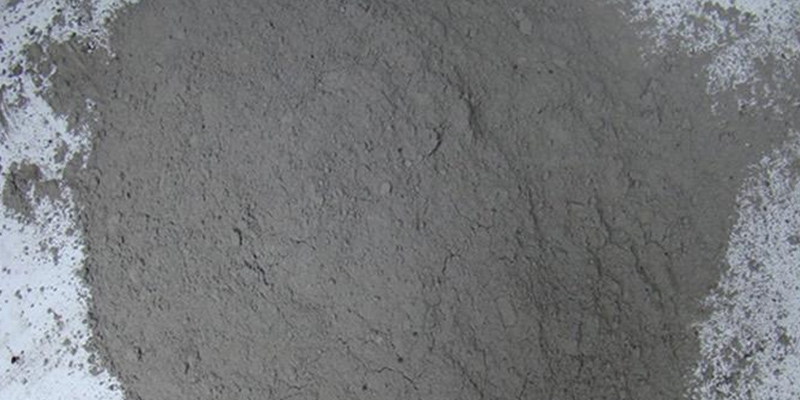
OPC cement is a hydraulic binding material produced by pulverizing clinker (primarily consisting of hydraulic calcium silicates) along with a small amount of gypsum. Known for its versatility, crack resistance, and low shrinkage, it remains the most widely used cement type in the global construction industry.
Chemical Composition of OPC Cement
The performance of OPC is determined by the precise ratio of its chemical components:
-
Calcium Oxide (CaO): 62% – 67% — The primary source of strength.
-
Silicon Dioxide (SiO₂): 17% – 25% — Determines durability and long-term strength.
-
Aluminum Oxide (Al₂O₃): 3% – 8% — Accelerates setting time for fast-hardening properties.
-
Iron Oxide (Fe₂O₃): 0.5% – 6% — Provides the characteristic grey color and acts as a flux during fusion.
-
Gypsum: 3% – 5% — Regulates setting time to prevent “flash sets,” ensuring sufficient workability for construction.
Expert Insight: Minor fluctuations in these chemical ratios determine whether the final product becomes Grade 33, 43, or 53. To maintain these precise ratios during production, reliable feeding and dust recovery systems are indispensable. Darko’s rotary airlock valves and baghouse dust collectors are specifically engineered for this high-precision industrial environment, ensuring batch-to-batch consistency.
How is OPC Cement Made?
The manufacturing of OPC is a sophisticated chemical transformation process divided into five key stages:
-
Crushing and Pre-homogenization
-
Process: Raw materials like limestone, clay, and iron ore are mechanically crushed.
-
Key Point: Crushed materials pass through a pre-homogenization yard. Scientific stacking and reclaiming ensure the raw mix is highly uniform, which is vital for stabilizing high-strength grades like OPC 53.
-
-
Raw Meal Grinding
-
Process: The homogenized materials are blended in exact proportions and ground into a fine “raw meal.“
-
Key Point: Particle fineness directly impacts the efficiency of chemical reactions inside the kiln.
-
-
Kiln Calcination (The Core Stage)
-
Process: Raw meal enters a cyclone preheater for decarbonization, then moves into a Rotary Kiln to be calcined at approximately 1450°C.
-
Key Point: At this extreme temperature, a solid-state reaction occurs, forming Clinker, the core strength component of cement.
-
-
Clinker Cooling and Gypsum Addition
-
Process: Hot clinker is rapidly cooled and mixed with 3%–5% gypsum.
-
Key Point: Gypsum controls the setting speed. Without it, cement would harden instantly upon contact with water, making it impossible to use on-site.
-
-
Finish Grinding
-
Process: The clinker and gypsum mixture undergoes a final round of high-fineness grinding.
-
Key Point: The finer the particles, the higher the cement activity and early strength performance.
-
What are the Three Grades of OPC Cement?
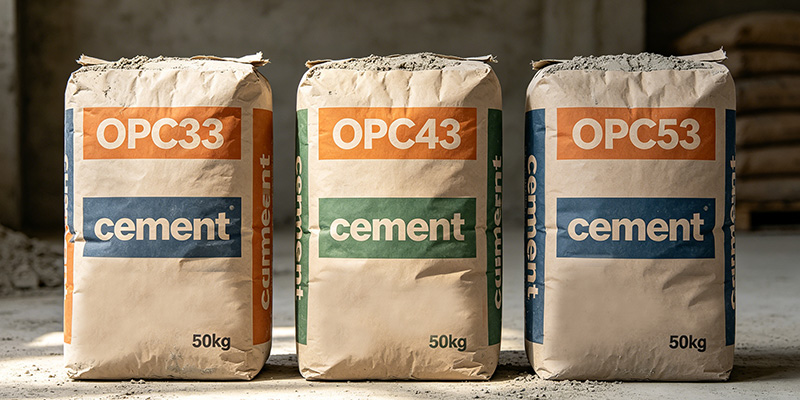
OPC cement is classified into three different grades based on its compressive strength after 28 days of curing (unit: megapascals, MPa): OPC 33 grade cement, OPC 43 grade cement, and OPC 53 grade cement. The higher the grade, the greater the compressive strength, and the more specific the application.
1. OPC 33 Grade Cement
-
Compressive Strength: ≥ 33 MPa after 28 days.
-
Characteristics: The lowest strength grade of OPC. While common in the past, it has largely been replaced by higher grades in modern structural engineering.
-
What is OPC 33 grade cement used for? It is the top choice for small residential construction, masonry, internal/external plastering, flooring, and non-load-bearing structures.
2. OPC 43 Grade Cement
-
Compressive Strength: ≥ 43 MPa after 28 days.
-
Characteristics: The most versatile “general-purpose” cement, offering a perfect balance between strength, setting time, and durability.
-
What is OPC 43 cement used for? Widely used in RCC (Reinforced Cement Concrete) structures, brick masonry, residential housing, road paving, and precast items like blocks and pipes.
3. OPC 53 Grade Cement
-
Compressive Strength: ≥ 53 MPa after 28 days.
-
Characteristics: A high-strength cement known for fast setting and rapid early strength gain, allowing for quicker formwork removal.
-
What is OPC 53 cement used for?Common uses of OPC 53: It is a core material in large-scale infrastructure projects, such as high-rise buildings, bridges, overpasses, concrete highways, and prestressed concrete structures.
Which cement is better, OPC or PPC?
The choice between OPC (ordinary Portland cement) and PPC (pozzolanic Portland cement) depends on your project objectives:
- When to choose OPC: If you prioritize construction speed, require high early strength, or are building high-rise structures.
- When to choose PPC: If you are constructing in coastal or highly corrosive environments (PPC offers better resistance to erosion), or undertaking mass concrete projects (such as dams), and you want a more environmentally friendly and cost-effective solution.
|
Comparison Items
|
OPC (Ordinary Portland Cement)
|
|
|
Composition
|
Clinker + Gypsum
|
Clinker + Gypsum + 20%–30% Fly Ash
|
|
Strength Growth
|
Fast setting and high early strength
|
Slow in the early stage, higher strength in the later stage
|
|
Heat of Hydration
|
High
|
Low, greatly reducing the risk of cracking
|
|
Durability and Corrosion Resistance
|
Ordinary, weak sulfate resistance
|
Excellent sulfate and moisture resistance
|
|
Market Price
|
10%–20% higher
|
Lower price
|
|
Environmental Emissions
|
High carbon emissions
|
20%–30% reduction in carbon emissions
|
|
Application Scenarios
|
Fast-track construction, high-strength load-bearing structures
|
Coastal projects, mass concrete, house construction and plastering in humid areas
|
Core Performance Characteristics of OPC Cement
- High Early Strength: Especially in Grade 53 cement, this significantly shortens the construction cycle.
- Soundness: Minimal volume change after curing reduces the risk of cracking.
- Excellent Compressive Strength: Provides long-lasting structural support.
- Workability: Exhibits good workability when mixed with aggregates and water.
Key Application Scenarios for OPC Cement
- Infrastructure Construction: Highways, railway tunnels, and airport runways.
- Industrial Facilities: Foundations for chemical plants, bulk cargo terminals, and bases for heavy machinery.
- High-Rise Buildings: Core walls, shear walls, and prestressed beams.
How to Select the Appropriate Grade of OPC Cement
- Consider the type of project: Choose Grade 53 for heavy-duty projects such as high-rise buildings and industrial plants; Grade 43 for ordinary residential buildings and standard construction; and Grade 33 for finishing work such as plastering and tile laying;
- Consider the climate and environment: In cold regions, prioritize OPC cement (high hydration heat, which aids curing); in coastal or humid regions, consider PPC cement;
- Consider the construction schedule: For tight deadlines or rapid formwork removal, choose Grade 53 OPC; for standard schedules, Grade 43 is sufficient;
- Consider budget constraints: When budgets are limited, choose Grade 43 OPC or PPC cement for standard construction to balance cost and performance.
FAQ
1.Is OPC cement suitable for home construction?
It is highly suitable. Grade 43 OPC cement is the top choice for foundations, floor slabs, and masonry, offering a balance of strength and value.
2.Can OPC cement be used for construction in cold winter temperatures?
Yes. OPC cement has high hydration heat, which accelerates setting in cold environments and reduces the impact of freezing.
3.How long can OPC cement be stored?
It is recommended to store it in a dry, well-ventilated area for no longer than
3 months. Prolonged storage can cause it to absorb moisture and clump, resulting in a significant decrease in strength.
4.What is the difference between Grade 43 and Grade 53 OPC cement?
The key difference lies in strength: Grade 53 has higher strength (≥53 MPa) and sets faster, making it suitable for high-rise construction; Grade 43 (≥43 MPa) meets all requirements for general residential buildings.
Conclusion
As a core material in modern construction, the selection of ordinary Portland cement (OPC) grades and production processes directly impact project quality and construction efficiency. This article helps you quickly grasp the fundamentals of OPC, enabling you to select the most suitable cement type based on your specific project requirements, while balancing structural integrity, construction efficiency, and cost control.