1. What is a Ship Loader?
A ship loader is a large-scale bulk cargo handling machine specifically designed for ports. It is primarily used in ports, terminals, and industrial stockpiles to load various types of bulk cargo into ship holds continuously and efficiently.
As a core component of bulk material logistics systems, ship loaders are widely used across a variety of industries, including coal terminals, ore berths, cement production facilities, grain ports, thermal power plants, and metallurgical plants.
Compared to intermittent loading and unloading equipment such as cranes and grab buckets, ship loaders rely on a complete belt conveyor system to achieve continuous bulk material loading operations. Ship loaders cannot operate independently; they must be paired with upstream feeding equipment to ensure a stable and uninterrupted material flow.
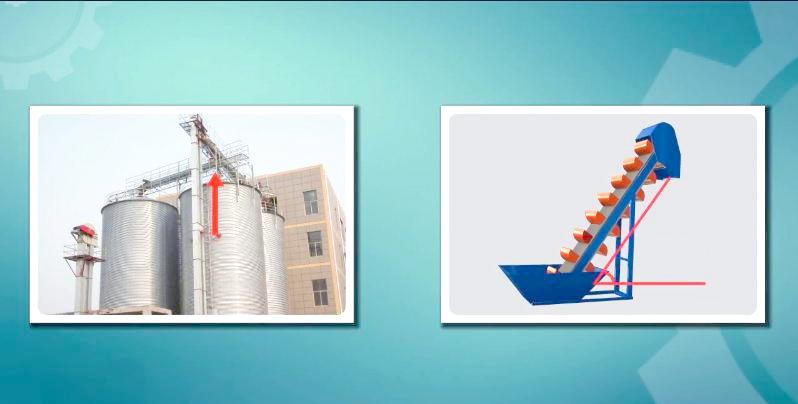
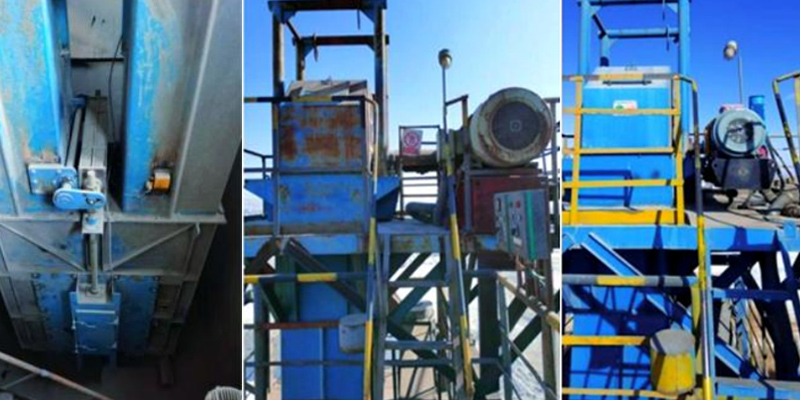
Common supporting equipment includes grain silo feeders, bucket wheel excavators, and ground-mounted fixed belt conveyors. The coordinated operation of multiple devices ensures the stable and efficient performance of loading operations.
Modern shiploaders integrate four core functions: travel, pitch, swing, and extension, allowing for precise adjustment of the operating position to achieve uniform material distribution within the ship’s hold.
The equipment offers a wide range of production capacities, with hourly output ranging from 500 tons to 8,000 tons, and is suitable for vessels ranging from 3,000-ton inland barges to 100,000-ton ocean-going bulk carriers.

2. What is Ship Loading?
Ship loading refers to the process of transferring dry bulk materials from stockpiles, silos, and conveyor systems into a ship’s cargo holds. It is the most critical process in port bulk handling and maritime logistics.
Common materials handled by shiploaders include coal, iron ore, grain, cement clinker, fly ash, chemical fertilizers, construction aggregates, and other types of bulk materials.
Compared to the complex structure of ship unloading processes, modern ship loading technology features a simpler design and more stable operation, making it easier to improve operational efficiency and reduce operating costs.
Currently, mainstream dry bulk terminals worldwide adopt belt-type ship loaders as a standardized loading solution, combined with various auxiliary machinery, to achieve automated, high-throughput, and low-dust bulk loading operations.
Professional, standardized ship loading operations must meet several core requirements: uniform material distribution, adjustable discharge height, effective dust control, prevention of material blockages, and stable operation.
At the same time, the equipment must adapt to operating conditions such as tidal water level changes and vessel positional shifts, ensuring that port loading operations are conducted safely, environmentally responsibly, and efficiently in all aspects.
3. Operating Principle of the Ship Loader
The ship loader loads bulk cargo using a fixed or mobile belt conveyor system. It relies on an extendable chute to smoothly transfer materials conveyed from land into the ship’s hold, creating a fully automated, continuous ship-loading cycle.
The entire operational process features stable logic and fixed procedures: First, upstream equipment such as bucket wheel excavators and hopper feeders continuously supply material, conveying it to the ground-level belt conveyor system.
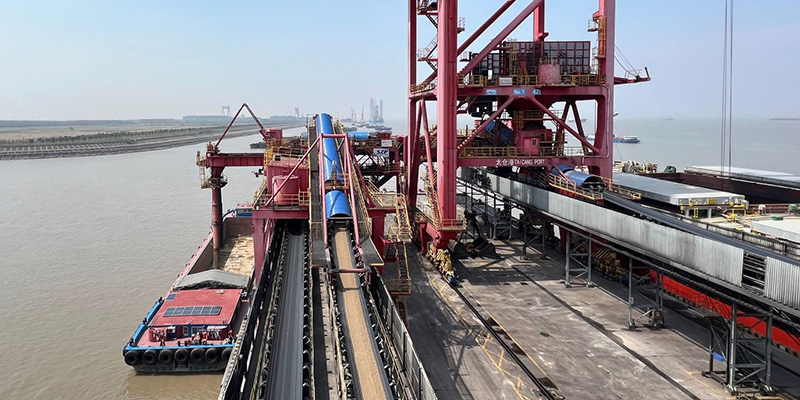
The material is then transported to the ship loader’s tail car for buffering and transfer, moved to the boom conveyor, and finally discharged into the ship’s cargo hold via the front-end telescopic chute.
Multiple mechanisms operate in synchronized coordination to ensure precise and efficient loading: the travel mechanism moves along the wharf tracks to align and calibrate the entire machine.
The slewing mechanism adjusts the horizontal working angle to expand the loading coverage; the tilt mechanism adjusts the boom height to accommodate fluctuations in water levels and changes in the ship’s draft.
The telescoping boom and chute allow for adjustment of conveying distance and discharge drop height, effectively preventing material spillage, breakage, and dust pollution.
The coordinated operation of multiple mechanisms ensures uniform loading across the entire ship’s hold, reduces the need for frequent vessel repositioning, shortens vessel berthing time, and significantly improves the terminal’s overall throughput efficiency.
4. Core Structural Components of the Ship Loader
The standard ship loader employs a modular mechanical design, with each structural component operating independently yet in coordination with others to support long-term, stable, and continuous operation of the equipment.
Travel Mechanism: Consisting of travel wheels, a gantry frame, rail clamps, and wind-resistant anchoring devices, this mechanism is responsible for moving the entire machine, ensuring precise positioning, and providing wind-resistant locking outdoors to guarantee operational safety under heavy-load conditions.
Tower Structure: This includes the main tower, operator cab, belt drive unit, and pitch drive system, serving as the core load-bearing structure that supports the boom and conveying system.
Boom System: The main boom is hinged to the gantry and supported by suspension cables; the telescopic boom slides along the main boom track to extend the horizontal loading coverage.
Telescopic Chute System: Mounted at the front end of the telescopic boom, it is equipped with hydraulic swing and rotation mechanisms, enabling 360° uniform material discharge, reducing material drop height, and suppressing dust at the source.
Tail Car Structure: Connected to the main tower via linkages, it handles material transfer buffering and steady-flow feeding, preventing blockages in the conveying system and ensuring continuous and stable material conveyance.
Electrical Control System: Supports automatic alignment, stepless speed regulation, real-time fault alarms, and remote intelligent operation and maintenance management, enabling automated equipment operation.
5. Mainstream Ship Loader Types
Based on the actual search habits of overseas users and real-world port applications, mainstream ship loaders in the industry are categorized by mobility, structural features, and material compatibility. These categories cover all high-traffic Google keywords: mobile, fixed, rail-mounted, and telescopic ship loaders, as well as professional models for coal, iron ore and grain, plus the core ship loading spout accessory.
5.1 Mobile Ship Loader
The mobile ship loader is a highly sought-after model with extremely high search volumes overseas. It requires no fixed tracks or complex civil engineering work. Featuring a lightweight design and flexible mobility, it can freely switch between operational berths.
This equipment offers exceptional adaptability and works well with grain, general bulk cargo, and construction materials. With low investment cost, high flexibility, and simple maintenance, it is widely used in small inland river terminals, temporary loading points, and short-distance bulk transshipment projects.
5.2 Fixed Ship Loader
Fixed ship loaders are permanently installed on pier foundations or berth platforms and do not have whole-machine mobility. They feature a robust structure, high load-bearing capacity, and an extremely low failure rate.
Equipped with slewing, tilting, and telescoping functions, fixed ship loaders achieve wide-range and uniform material distribution. They perfectly match fixed berths with stable shipping routes and maintain excellent long-term stability under heavy-load operation for energy and building material terminals.
5.3 Rail-mounted Ship Loader
The rail-mounted ship loader is the mainstream heavy-duty model for large seaports. It travels straight along embedded wharf rails, delivering precise positioning, smooth movement, and strong heavy-load performance.
It supports full-range slewing, tilting, and telescopic movements to cover multiple hatches and large working areas. It effectively reduces vessel repositioning frequency and greatly improves terminal throughput, making it ideal for large-scale coal and iron ore bulk loading.
5.4 Telescopic Ship Loader
The telescopic ship loader adopts a dual-telescopic structure with a telescopic boom and a retractable ship loading spout. It flexibly adjusts the working radius and discharge height to adapt to changing water levels and different ship types.
Compared with ordinary models, it provides more uniform material distribution and wider coverage. It also effectively reduces material drop height, minimizing cargo breakage, spillage, and dust generation. It can be matched with fixed, rail-mounted, or mobile bases for versatile applications.
5.5 Coal Ship Loader
Coal ship loaders adopt reinforced wear-resistant, anti-clogging, and heavy-duty structures. They handle large-volume, continuous coal loading with stable and reliable performance. These professional loaders fully meet the high-output and long-hour operation requirements of specialized coal terminals.
5.6 Iron Ore Ship Loader
Iron ore ship loaders feature enhanced structural rigidity and impact resistance. They safely load heavy, sharp, and lumpy ore materials such as iron ore and slag. The reinforced design ensures stable, high-intensity operation in professional mineral terminals.
5.7 Grain Ship Loader
Grain ship loaders adopt fully enclosed, crush-resistant, and low-dust structures. Equipped with buffer feeding systems and anti-breakage devices, they effectively prevent grain damage, spillage, and dust pollution, complying with strict grain logistics and environmental standards.
5.8 Core Accessory: Ship Loading Spout
The ship loading spout is a high-traffic long-tail keyword and an essential core component for all bulk ship loaders. Its multi-layer sealed telescopic structure adapts to different hatch heights and reduces material drop height.
This design suppresses flying dust at the source, minimizes material loss, and achieves environmentally friendly and smooth loading for grain, coal, iron ore, powder, and various dry bulk materials.
6. Application Scenarios of Specialized Ship Loaders
Grain Ship Loader: Custom-designed for wheat, corn, soybeans and other fragile grain materials, grain ship loaders adopt cushion feeding structures and fully enclosed conveying channels. They effectively avoid grain breakage and dust pollution while meeting professional grain storage and logistics standards.
Cement Ship Loader: Optimized for ultra-fine powder materials such as cement and fly ash, this type of ship loader uses a wear-resistant fully sealed design with reserved dust removal interfaces to realize zero-dust environmentally friendly loading.
Mobile Lightweight Ship Loader: This movable loader requires no track laying or complex civil works. It can flexibly switch working sites and is suitable for temporary loading projects, small inland terminals, and flexible bulk transshipment.
7. Three Main Ship Loading Operating Modes
Fixed-Machine, Moving-Vessel Operation: The ship loader is fixed on the pier. Workers adjust the ship position to align different hatches for loading. This mode costs less in civil construction and runs stably, which is widely used in inland river ports.
Fixed-Vessel, Moving-Machine Operation: The vessel stays moored at a fixed berth, while the rail-mounted ship loader travels along the dock to cover all hatches. It offers high flexibility and adapts to various ship types, becoming the mainstream solution for large deep-water seaports.
Swing Operation Mode: The equipment completes full-coverage loading through linear or arc swinging without long-distance rail movement. It provides high cost performance and is ideal for medium and small terminal renovation projects.
8. Core Advantages of Modern Ship Loaders
Continuous High Efficiency: Ship loaders support non-stop bulk conveying, greatly shorten vessel berthing time, and improve terminal overall throughput.
Wide Material Compatibility: They adapt to powder, granular and lump bulk materials, including coal, iron ore, grain, cement, fertilizer and industrial bulk cargoes.
Low-Dust & Eco-Friendly: The matched sealed ship loading spout and dust removal interfaces effectively control dust emissions, meeting international port environmental standards.
High Automation: Automatic positioning, intelligent distribution, adaptive height adjustment and remote monitoring reduce labor costs and operational risks.
Strong Site Adaptability: Multiple models cover large seaports, medium terminals, and small temporary berths to meet diverse project demands.
11. Ship Loader Type Comparison
Different ship loader models have distinct advantages and applicable scenarios. The following comparison covers all mainstream high-search-volume types, helping users quickly select the right equipment for their port projects.
|
Ship Loader Type
|
Core Advantages
|
Limitations
|
Best Application Scenarios
|
|---|---|---|---|
|
Mobile Ship Loader
|
Flexible movement, no track construction required, low investment cost, simple maintenance, high site adaptability
|
Limited hourly loading capacity, not suitable for super-large-scale heavy-duty operations
|
Small inland river terminals, temporary loading points, short-distance bulk transshipment projects
|
|
Fixed Ship Loader
|
Robust and stable structure, extremely low failure rate, strong load-bearing capacity, long service life
|
No whole-machine mobility, poor flexibility for variable berth layouts
|
Fixed professional berths, energy and building material dedicated terminals with stable shipping routes
|
|
Rail-mounted Ship Loader
|
High positioning precision, heavy-load performance, large loading coverage, high terminal throughput efficiency
|
Requires professional track laying and civil engineering, high overall project cost
|
Large coastal deep-water seaports, professional coal and iron ore bulk terminals
|
|
Telescopic Ship Loader
|
Adjustable working radius and discharge height, uniform material distribution, effective dust and cargo breakage control
|
Higher configuration cost than ordinary conventional models
|
Terminals with variable water levels, diverse ship types and high environmental protection requirements
|
|
Coal Ship Loader
|
Wear-resistant, anti-clogging, heavy-duty design, stable for long-hour and high-volume continuous loading
|
Professional customized structure, single material applicability
|
Specialized coal terminals and large energy port projects
|
|
Iron Ore Ship Loader
|
Reinforced structural rigidity, excellent impact resistance, adapted to heavy and sharp lump materials
|
High structural strength requirements, higher manufacturing cost
|
Mineral terminals, iron ore and slag bulk loading projects
|
|
Grain Ship Loader
|
Fully enclosed, anti-breakage and low-dust design, compliant with grain logistics environmental standards
|
Not applicable for heavy abrasive bulk materials
|
Grain ports, agricultural product bulk transshipment terminals
|
12. Daily Maintenance and Service Life
Standardized periodic maintenance is essential for long-term stable ship loader operation. Operators need to regularly check belt wear and deviation, and adjust correction devices in a timely manner.
It is necessary to lubricate slewing bearings, traveling wheels and hydraulic parts on schedule, clean accumulated materials inside the ship loading spout and guide trough, and prevent material caking and blockage.
Inspect sealing performance and dust removal connections regularly to avoid equipment corrosion. Calibrate electric control systems and sensors to ensure accurate automatic operation, reduce failure rates, and extend service life.
13. FAQ
1. What is the difference between a ship loader and a ship unloader?
A ship loader completes shore-to-ship bulk loading, while a ship unloader performs ship-to-shore unloading. Ship loaders have simpler structures, lower failure rates, and more stable continuous working performance.
2. What materials can a ship loader handle?
Ship loaders handle almost all dry bulk materials, including grain, coal, iron ore, cement, fly ash, fertilizer, sand and other powdered, granular and lumpy bulk cargoes.
3. What are the main types of ship loaders?
The mainstream types include mobile ship loader, fixed ship loader, rail-mounted ship loader and telescopic ship loader. Custom professional models include coal ship loader, iron ore ship loader and grain ship loader, all equipped with functional ship loading spouts.
4. Which ship loader is best for small ports?
A mobile ship loader is the best choice for small inland terminals and temporary berths, as it requires no track construction and offers flexible, low-cost operation. Large fixed heavy-duty ports prefer rail-mounted or fixed ship loaders.
5. How to solve dust problems during ship loading?
The sealed telescopic ship loading spout is the core solution. It reduces material drop height and connects with professional dust removal systems to realize dust-free and eco-friendly bulk loading.
6. Does a ship loader need supporting feeding equipment?
Yes. A ship loader cannot work independently. It must cooperate with silo feeders or bucket wheel reclaimers to obtain continuous and stable material flow for normal operation.
7. What are the mainstream working modes of ship loaders?
There are three core modes: fixed-machine moving-ship, fixed-ship moving-machine, and swing-type flexible operation, adapting to different port scales and berth conditions.