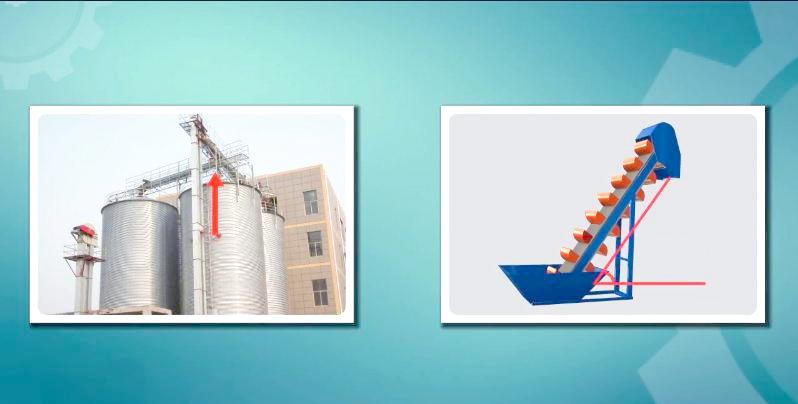
A bucket elevator is a type of conveying equipment designed for the vertical transport of materials. It offers advantages such as a simple structure, low maintenance costs, high conveying efficiency, the ability to handle significant vertical heights, stable operation, and a wide range of applications. Widely used in industries such as cement, mining, and building materials, it is one of the core pieces of equipment for the vertical conveyance of bulk materials.
How Does A Bucket Elevator Work?
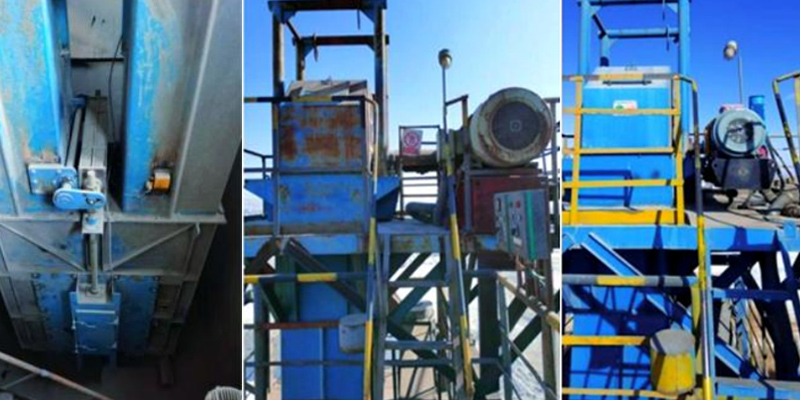
A bucket elevator operates by scooping material from a storage bin below using buckets, which are then lifted to the top by a conveyor belt or chain. After passing over the top pulley, the buckets tip downward, discharging the material into a receiving hopper. In belt-driven bucket elevators, the drive belt is typically made of rubber and is mounted on the drive pulley at the bottom or top, as well as on the return pulleys at the top and bottom. Chain-driven bucket elevators generally feature two parallel drive chains, with a pair of drive sprockets at the top or bottom and a pair of return sprockets at the bottom or top.
How Many Types Of Bucket Elevators Are There?
Bucket elevators come in a variety of designs to accommodate different materials and operating conditions. Classification by discharge method is the most fundamental and core approach, dividing them into two main categories: centrifugal bucket elevators and continuous bucket elevators.
Centrifugal bucket elevators operate at relatively high speeds. Material is ejected from the buckets at the head section by centrifugal force, resulting in high discharge efficiency. They are particularly suitable for fine powders and small-particle materials with good flowability and are widely used in cement, grain, mining, and general industrial conveying applications.
Continuous bucket elevators operate at lower speeds with densely arranged buckets. Material is discharged smoothly by gravity as the buckets invert, offering superior protection for fragile, large-sized, abrasive, or easily damaged materials. This design effectively reduces material breakage rates and dust generation.
Based on the two discharge methods described above, both types of bucket elevators can be further configured according to their drive mechanisms as follows:
Belt-driven bucket elevators: These offer smooth operation, low noise, and high cost-effectiveness, making them suitable for conveying non-abrasive materials under medium to low loads.
Chain-driven bucket elevators: These offer higher load-carrying capacity, superior wear resistance, and better high-temperature tolerance, making them suitable for conveying heavy-duty, highly abrasive, and high-temperature bulk materials.
By combining different discharge methods with traction types, we can tailor specialized solutions for various heavy-duty applications, including cement, mining, and building materials.
Common Problems with Bucket Elevators and Their Solutions
1. Bucket Belt Slippage
(1) A bucket elevator relies on the frictional torque between the bucket belt and the drive shaft of the head pulley to lift material. If the bucket belt is not sufficiently tensioned, slippage will occur. In this case, immediately shut down the machine and use the tensioning device to tighten the bucket belt. If the tensioning device cannot fully tighten the bucket belt, it indicates that the device’s travel is insufficient and needs to be readjusted. Correct procedure: Unfasten the bucket belt joint, adjust the bottom pulley tensioning device to its highest position, thread the bucket belt through the head section, route it around the head and bottom pulleys, and reconnect it to place the belt in a pre-tensioned state. Then fully tighten the tensioning device. At this point, the remaining travel of the tensioning screw should not be less than 50% of the total travel.
(2) Overloading of the elevator. Overloading increases the operating resistance torque, causing the bucket belt to slip. Reduce the feed rate appropriately and ensure uniform feeding. If slippage persists after reducing the feed rate, there may be excessive material buildup inside the machine frame or the bucket belt may be jammed by foreign objects; shut down the machine to inspect and troubleshoot the issue.
(3) If the drive shaft of the head pulley and the inner surface of the bucket belt are too smooth, resulting in insufficient friction, slippage may occur. Apply rubber lining to the surface of the drive shaft or the inner side of the bucket belt to increase the coefficient of friction.
(4) If the bearings of the head pulley or tail pulley do not rotate smoothly, increased resistance will also cause slippage. Disassemble and clean the bearings, reapply grease, or replace the bearings directly.
2. Bucket Belt Deviation
(1) The head wheel and bottom wheel drive shafts are not installed correctly, which is mainly manifested as:
The two wheels are not in the same vertical plane and not parallel
Both wheels are horizontal but not in the same vertical plane
The two wheels are parallel and coplanar but not horizontal
All the above situations will lead to bucket belt deviation, which is likely to cause problems such as bucket collision with the machine barrel and bucket belt tearing. Stop the machine immediately for adjustment to ensure that the head wheel and bottom wheel drive shafts are in the same vertical plane and kept horizontal. The vertical deviation of the whole machine center line within 1000mm height should not be greater than 2mm, and the cumulative deviation should not be greater than 8mm. Correct installation of drive shafts is the premise to avoid bucket belt deviation.
(2) The bucket belt joint is not correct, and the edge of the joint is not in a straight line. During operation, one side will be tight and the other side will be loose, making the bucket belt deviate to the tight side. This will lead to insufficient material receiving of the bucket, incomplete discharging, increased material return, and even edge jamming and belt tearing in severe cases. Stop the machine to re-calibrate and fasten the joint. Ensuring the correctness of the bucket belt joint can effectively prevent deviation.
3. Excessive Material Return
Material return refers to the situation that materials are not completely discharged in the discharging area and some materials fall back into the machine base. Excessive material return will reduce efficiency, increase energy consumption and improve material breakage rate. Main reasons:
(1) The bucket running speed is too fast. Different materials have different applicable speeds:
Dry powder and granular materials: 1~2m/s
Bulk materials: 0.4~0.6m/s
Moist powder and granular materials: 0.6~0.8m/s
Excessively high speed will lead to premature discharging and material return, so the running speed should be appropriately reduced according to the material type. Adjusting the bucket running speed according to the material characteristics can effectively reduce material return.
(2) The position of the discharge tongue plate at the machine head is improper, and the distance from the bucket discharge area is too large, which will also cause a lot of material return. The position of the tongue plate needs to be adjusted in time. Correct installation of the discharge tongue plate is an important measure to reduce material return.
4. Bucket Falling
During production, the bucket falls off the bucket belt accompanied by abnormal noise, which requires immediate shutdown for inspection, otherwise it will cause more bucket damage and bucket belt tearing. Main reasons:
(1) The feeding amount is too large, the material accumulation in the machine base is serious, the running resistance increases sharply, and the bucket is blocked, deformed and falls off. Stop the machine immediately, pull out the machine base insert plate to discharge the accumulated material, replace it with a new bucket before restarting, and reduce and uniformly feed. Controlling the feeding amount and cleaning accumulated material in time can prevent bucket falling.
(2) The feeding port is too low. Under normal circumstances, the bucket should scoop up materials by itself. If the feeding port is too low, a lot of materials will directly enter the machine base, and the bucket will forcibly dig materials, especially bulk materials, which are very easy to cause bucket deformation and falling off. The feeding port should be adjusted above the center line of the bottom wheel. Adjusting the height of the feeding port can avoid forced digging of the bucket.
(3) The bucket material is poor and the strength is insufficient. As a bearing component, the bucket should be made of high-strength steel plate or galvanized plate, and the edge should be folded or embedded with wire for reinforcement. Choosing high-quality bucket materials is the foundation to ensure the service life of the bucket.
(4) The accumulated material in the machine base is not cleaned before starting. When restarting after shutdown, the residual accumulated material will impact the bucket, leading to fracture and falling off. Therefore, the accumulated material in the machine base must be cleaned before starting. At the same time, the bucket fixing bolts should be regularly inspected, and if looseness, falling off, bucket skew and damage are found, they should be repaired or replaced in time. Regular inspection and maintenance can effectively prevent bucket falling.
5. Bucket Belt Tearing
The conveyor belt of the bucket elevator is mostly canvas belt or rubber belt, which is prone to tearing under the combined action of various faults, which is a relatively serious fault. Bucket belt deviation and bucket falling are the main incentives, so it is necessary to comprehensively investigate and eliminate the faults. In addition, if sharp-edged foreign objects are mixed in the materials, the conveyor belt will also be cut. Therefore, a wire mesh or iron removal device should be set at the feeding port to prevent large hard objects from falling into the machine base. Installing an iron removal device and a wire mesh can effectively protect the bucket belt from tearing.
If you use bucket elevators in cement, mining and building materials production lines, welcome to contact us to get targeted selection schemes and fault solutions. We have rich experience in bucket elevator customization and after-sales service.
We also provide industrial dust removal equipment and bucket elevator supporting dust removal solutions to effectively control dust pollution. Our bucket elevator supporting dust removal solutions can meet the environmental protection requirements of various industrial production lines.