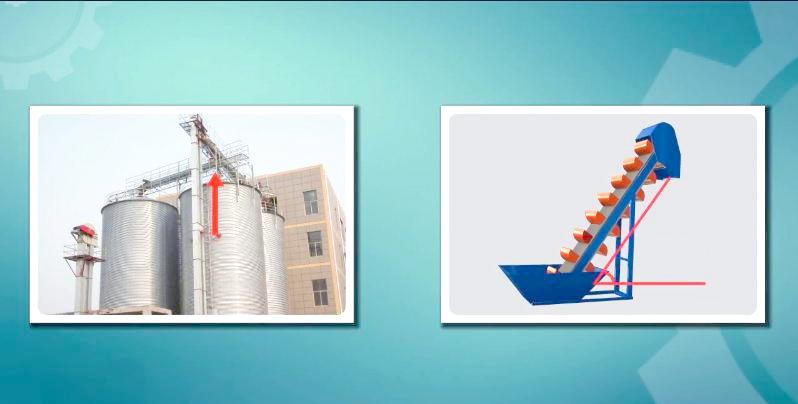
In industrial production, both the bucket belt conveyor and the bucket elevator are essential continuous handling equipment. However, they are fundamentally different in design philosophy and application. Choosing the right equipment requires understanding their key differences and where they are best used.
1. Introduction to Each Equipment
Bucket Belt Conveyor
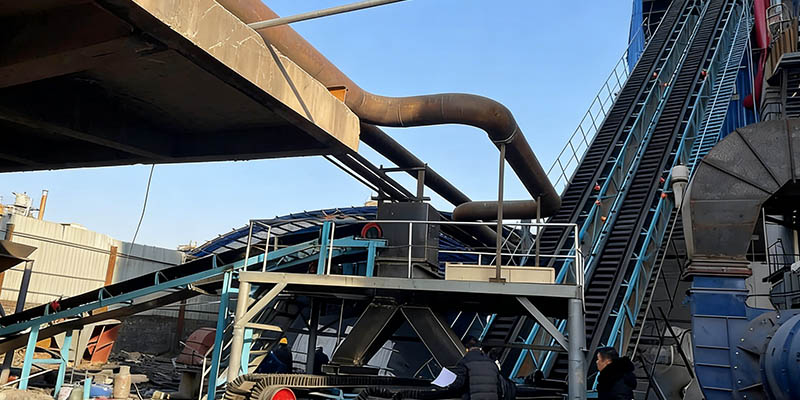
Think of a bucket belt conveyor as a standard belt conveyor fitted with evenly spaced “buckets” or “sidewalls.” It uses a continuous loop belt as the driving and carrying mechanism. A motor drives a drum, which moves the belt and its attached buckets along supporting idlers. Its main advantage is route flexibility. It can move materials over long distances, horizontally, on inclines, or even along a “Z” shaped path, like a customizable “automatic conveyor belt.” Its purpose is to solve the problem of moving material from point A to point B, especially when these points are not vertically aligned.
Bucket Elevator
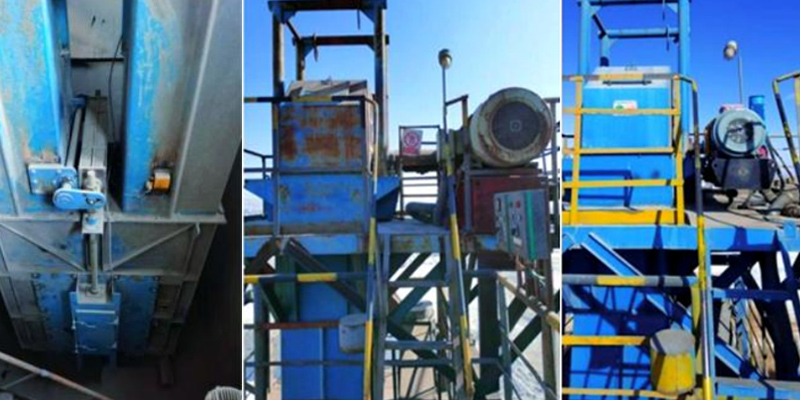
A bucket elevator is a high-efficiency device designed specifically for vertical lifting. Its core structure is an enclosed casing. Inside, a chain or belt with many buckets circulates continuously. A motor drives a top sprocket or drum. This motion lifts buckets filled with material from the bottom (inlet) to the top. At the top, centrifugal force or gravity discharges the material through an outlet. The whole system works like a vertical “bucket elevator.” Its sole purpose is to solve the problem of moving material from a low point to a high point, using minimal floor space.
2. Key Differences
2.1 Layout and Conveying Path
-
Bucket Belt Conveyor: It focuses on linear and flexible layout. Its incline is adjustable, typically between 0° and 70°. It handles horizontal transport, climbing, or specific inclined paths.
-
Bucket Elevator: It focuses on compact and vertical layout. Its path is fixed as vertical or near-vertical (incline > 70°). Its main goal is to save horizontal floor space.
2.2 Working Principle and Material Impact
-
Bucket Belt Conveyor: Material rests in buckets and moves smoothly with the belt. This friction-driven method is stable and causes less vibration. It results in lower crushing and breakage for granular materials.
-
Bucket Elevator: Material goes through a cycle of digging, vertical lifting, and high-speed discharge. This traction-driven method involves impact during discharge. Therefore, the risk of product damage is higher, especially for fragile or abrasive materials.
2.3 Material Properties and Suitable Environment
-
Bucket Belt Conveyor: It tolerates higher moisture and stickiness in materials. Its open structure allows easy inspection and maintenance. However, you may need covers to control dust when handling powders.
-
Bucket Elevator: Its fully enclosed structure is a natural advantage. It effectively contains dust and protects material from moisture. It is inherently suitable for dusty, explosive, or clean environments. However, wet and sticky materials can cause problems like poor discharge and clogging.
3. Typical Industry Applications
Their different features make them suitable for distinct fields.
Common uses for Bucket Belt Conveyors:
-
Mining and Aggregates: Transporting materials like ore, crushed stone, and sand over long distances or steep inclines from crushers to stockpiles or between screens. Durability and route flexibility are key here.
-
Agriculture and Grain Processing: Moving bulk grain from trucks on an incline to the top of silos, or connecting different processing stages (cleaning, milling). It handles wheat, corn, and soybeans.
-
Chemical and Plastics: Conveying slightly damp or sticky plastic pellets (PE, PP) or chemical granules from production to elevated reactors or mixers. Its gentle handling reduces particle damage.
-
Construction and Building Materials: Transporting powders like cement or fly ash (with covers), or moving aggregates on an incline to the mixer in a concrete batching plant.
Common uses for Bucket Elevators:
-
Flour, Feed, and Food Processing: This is its primary field. It vertically lifts grains, flour, or feed ingredients to the top of large silos or processing equipment. Its enclosed design perfectly meets strict requirements for hygiene, dust control, and contamination prevention.
-
Cement and Metallurgy: In cement plants, it vertically conveys raw meal, clinker, or coal powder to preheaters or storage. In metallurgy, it lifts ore or coke to blast furnace tops. Its high strength and heat resistance are crucial here.
-
New Energy and Advanced Materials: Used in production lines for high-value powders like battery cathode/anode materials or quartz sand. It enables closed, dust-free vertical transfer between cleanrooms on different floors, preventing contamination.
-
Ports and Grain Silos: It acts as the “heart” of the operation. It vertically lifts grain from ships or trucks to the top of very tall silos for storage. This is the highest-capacity critical link.
4. Selection Guide
Your choice finally depends on your specific process needs:
-
First, consider the path. Choose a Bucket Belt Conveyor for horizontal or inclined transport. Choose a Bucket Elevator for pure, efficient vertical lifting.
-
Then, consider the material. Prefer a Bucket Belt Conveyor for fragile, moist, or sticky materials. A Bucket Elevator is better for dry powders/granules requiring dust containment.
-
Finally, follow industry practice. Bucket Elevators are standard for vertically lifting food, grain, and high-value powders. Bucket Belt Conveyors are common for mining, aggregates, and long-distance bulk material transfer.
This analysis covers principles, differences, and real-world applications. It helps you match equipment features to your production needs for a more precise and efficient selection