In the field of industrial dust control, cyclone dust collectors are often misunderstood — just a low-cost coarse powder separator with poor dust removal efficiency and unable to take on important tasks. But the truth is quite the opposite: under specific working conditions, the stability and ease of use of cyclone dust collectors are far superior to those of baghouse dust collectors and cartridge dust collectors. They can not only reduce equipment maintenance costs but also effectively extend the service life of the entire dust collection system, while helping enterprises meet industrial dust emission regulations. Today, we will deeply dissect the advantageous working conditions of cyclone dust collectors and discuss why they can become the better choice in these scenarios.
What is a Cyclone Dust Collector?
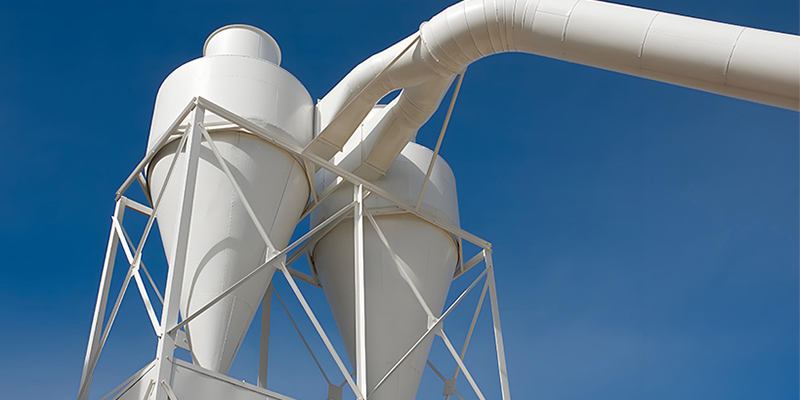
A cyclone dust collector is a dry dust removal equipment designed based on the principle of centrifugal force, belonging to a type of inertial dust collector. It is widely used in pre-treatment or independent treatment scenarios of industrial dust control. Its core structure is simple, mainly composed of an air inlet, an air outlet, a cyclone cylinder, an ash hopper and other parts. It does not rely on vulnerable materials such as filter media and filter bags, and achieves efficient separation of dust and gas through a rigid structure. It has the characteristics of small volume, low investment, simple maintenance and strong adaptability. It is one of the most commonly used dust removal equipment in industrial production, which can handle various dry, non-sticky and coarse particle dust, and adapt to a variety of complex industrial working conditions.
Working Principle of Cyclone Dust Collectors
The core working principle of a cyclone dust collector is to realize the separation of dust particles and gas by the synergistic effect of centrifugal force and gravity. Dust-laden gas enters the cyclone cylinder tangentially through the air inlet, forming a high-speed rotating air flow (rotational flow field) inside the cylinder. During the rotation, the air flow generates strong centrifugal force, which throws the dust particles with much higher density than gas to the cylinder wall. After hitting the cylinder wall, the dust particles slide down to the ash hopper at the bottom under the action of gravity to complete the collection of dust; while the purified gas is driven by the rotating air flow and discharged from the central exhaust pipe, thus realizing the purpose of dust control and gas purification. Its separation efficiency mainly depends on the rotating speed of the air flow, the particle size and density of dust particles, and the rationality of the equipment structure design.
High Concentration Dust Working Condition: Reducing the Burden on the Rear End
Working Condition Pain Points
When dealing with extremely high dust concentration, if baghouse or cartridge dust collectors are directly used, three core problems will be faced: the wear speed of filter bags is accelerated sharply, which greatly shortens the service life of filter media; the pressure difference of the equipment rises frequently, affecting the overall air volume of the system; the ash cleaning system is forced to start frequently, which not only increases energy consumption but also aggravates the loss of filter bags, resulting in high maintenance costs. This is also a common problem of equipment failure and cost overrun faced by many overseas enterprises in high-concentration dust treatment.
Core Advantages of Cyclone Dust Collectors
Relying on the rigid structure design, cyclone dust collectors realize dust separation by using centrifugal force without relying on filter media, which is naturally suitable for high concentration dust scenarios. Its core functions are reflected in: first, separating a large number of large particle dust in advance to directly reduce the processing load of the rear-end baghouse and cartridge; the pressure difference is stable during operation with small fluctuation range; the number of ash cleaning is greatly reduced, which effectively reduces the equipment maintenance pressure, extends the system operation cycle, and reduces energy consumption, meeting the demand for “energy-efficient dust collector” concerned by Google users.
Engineering Case: In high-frequency and high-concentration dust working conditions such as coal powder and mineral powder treatment, Hebei Chuxin Environmental Protection has greatly reduced the operation pressure of the rear-end baghouse through the combined scheme of “front-end cyclone pre-separation + rear-end baghouse deep filtration”. The service life of filter bags has been extended by more than 30%, and the system operation and maintenance cost has been reduced by 25%, helping enterprises achieve a win-win situation of compliance and economy in dust control. Such combined dust collection system is also the mainstream choice of overseas industrial enterprises.
Wide Particle Size Distribution Dust Working Condition: More Efficient Grading Treatment
Working Condition Pain Points
Some industrial dust has obvious particle size stratification, usually 50% large particle dust and 50% fine particle dust. If a single baghouse or cartridge dust collector is used, the coarse particle dust will directly impact the surface of the filter media, causing wear and breakage of the filter bags; at the same time, the fine particle dust is difficult to be completely captured by a single filter media, which is easy to lead to excessive emissions, failing to meet the strict industrial dust emission standards in Europe, America and other regions, and bringing compliance risks to enterprises.
Core Advantages of Cyclone Dust Collectors
For dust with wide particle size distribution, cyclone dust collectors can play the core role of “coarse separation pre-treatment”: first, efficiently separate large particle dust to avoid its impact and wear on the rear-end filter media; then the fine particle dust enters the baghouse or cartridge for deep filtration, forming a “cyclone + filter media” multi-stage separation system.
This combined mode can not only improve the overall dust collection efficiency and ensure emission compliance but also effectively protect the rear-end filter media equipment, reduce the maintenance frequency, and achieve the triple effects of “high efficiency + energy saving + long-term effect”, perfectly solving the two core pain points of “dust emission compliance” and “equipment maintenance cost control” concerned by Google users.
Dry, Non-sticky Dust Working Condition: Low Maintenance and More Stability
One of the optimal adaptation scenarios for cyclone dust collectors is the dry, non-sticky dust working condition — this type of dust contains no moisture or extremely low humidity, and is not easy to adhere to the inner wall of the equipment, so there is no need to worry about dust blocking and wall scaling. It is also the most common type of dust in industries such as food processing and wood processing industry. The search volume of “low-maintenance dust collector” by users in related industries on Google remains high all year round.
Core Advantages
Under this working condition, dust will not adhere and accumulate on the plate wall and ash hopper of the cyclone dust collector, the ash discharge of the ash hopper is smooth, and there is no need to add additional ash cleaning auxiliary equipment; the equipment can operate stably for a long time with almost no additional maintenance during operation, which greatly reduces the operation and maintenance labor cost and consumable cost of enterprises, especially suitable for small and medium-sized enterprises (SMEs) to control the dust control budget.
High Temperature Gas Dust Working Condition: High Temperature Resistance and More Durability
Working Condition Pain Points
The core shortcoming of baghouse dust collectors is sensitivity to temperature. When the temperature of the treated gas exceeds the tolerance limit of the filter media (usually 120-180℃), the filter media will age and break quickly, leading to the failure of the dust collection system, and even frequent replacement of filter media, increasing enterprise costs; while high temperature gas dust treatment is very common in industries such as metallurgy, ceramics and sintering. Google users often search for “high temperature resistant dust collector” to find solutions.
Core Advantages of Cyclone Dust Collectors
Cyclone dust collectors have a simple structure, mostly made of metal or high-temperature resistant special materials. They do not rely on filter media and can directly handle high-temperature gas (some customized models can withstand temperatures above 800℃); at the same time, their rigid structure is not easy to deform or damage due to thermal expansion, with strong adaptability. There is no need to add additional cooling equipment, which further reduces the equipment investment and energy consumption of enterprises.
Typical Application Scenarios: In high-temperature dust control working conditions such as metallurgy, ceramics, sintering and boiler flue gas, the stability performance of cyclone dust collectors is far superior to that of baghouse and cartridge dust collectors. Moreover, there is no limit on the service life of filter media, and they can operate continuously for a long time, perfectly adapting to the dust control needs of high-temperature industrial scenarios, and are also one of the preferred dust removal equipment for overseas high-temperature manufacturing industries.
Coarse Particle-based Dust Working Condition: Low Cost and High Reliability
Typical Working Conditions
Sand and gravel crushing dust, foundry shakeout dust, wood processing dust, ore crushing dust, etc. The core characteristics of this type of dust are: large particle size, high density and low viscosity. It does not require complex deep filtration, and only needs efficient separation to meet environmental protection requirements. Such working conditions are very common in overseas construction and mining industry, and the demand for “low-cost dust collector” by relevant users is strong.
Core Advanta+ges of Cyclone Dust Collectors
For coarse particle dust, cyclone dust collectors can quickly separate dust from gas through centrifugal force, with a separation efficiency of more than 90%; the equipment structure is simple, the investment cost is only 30%-50% of that of baghouse dust collectors, and the maintenance cost is extremely low. During operation, there are almost no problems such as dust blocking and filter media wear, which is stable and reliable, and the cost performance is far higher than other dust removal equipment. It is especially suitable for enterprises with limited budget and pursuing practical dust control solutions.
Why Are Cyclone Dust Collectors More Stable Under These Working Conditions?
Combined with the above working conditions, we summarize the 4 core logics for the stable operation of cyclone dust collectors, helping you thoroughly understand the nature of their advantages, and answering the core questions often asked by Google users such as “Which is more cost-effective, cyclone dust collector vs baghouse dust collector” and “How to save energy with cyclone dust collectors”:
Strong Rigid Structure and Outstanding Anti-interference Ability: Different from the flexible filter media of baghouse and cartridge, cyclone dust collectors adopt a full rigid structure, which is not affected by environmental factors such as dust concentration, temperature and humidity (dry working conditions), with stronger operation stability and reduced equipment failure downtime. This is also the core advantage that distinguishes it from other dust removal equipment.
Simple Ash Cleaning System and Low Maintenance Cost: It does not need complex ash cleaning components such as pulse injection and solenoid valves, and only relies on its own structure and gravity for ash discharge, which reduces the use of vulnerable parts, has simple maintenance processes and extremely low failure rate, and greatly reduces the operation and maintenance cost of enterprises, which is also one of the core selling points concerned by Google users.
Stable Flow Field and Small Pressure Difference Fluctuation: Under the premise of reasonable design of wind speed and inlet structure, a stable rotational flow field can be formed inside the cyclone dust collector, the dust separation mechanism is more stable, the pressure difference fluctuation of the equipment is small, and there will be no frequent alarm and shutdown, ensuring production continuity, especially suitable for continuous production enterprises.
Adapting to Extreme Working Conditions with No Obvious Shortcomings: For extreme working conditions such as high temperature, high concentration and coarse particles, baghouse and cartridge dust collectors have obvious limitations. However, relying on their structural characteristics, cyclone dust collectors can be easily adapted, without restrictions on filter media life and temperature tolerance, and at the same time, they have lower energy consumption, which conforms to the global industrial development trend of “energy saving and consumption reduction”.
Working Condition Adaptation and Selection Comparison Table
|
Condition Type
|
Core Advantages of Cyclone Dust Collectors
|
Selection Notes
|
|
High Concentration Dust
|
Separating coarse particles in advance, reducing the burden on rear-end equipment, and saving energy and reducing consumption
|
The best effect is achieved when used with baghouse/cartridge, complying with emission regulations
|
|
Wide Particle Size Dust
|
Grading separation, protecting filter media, and improving overall dust collection efficiency
|
Build a multi-stage separation system to meet European and American emission standards
|
|
Dry, Non-sticky Dust
|
No dust blocking, easy ash discharge, low maintenance, and long-term stable operation
|
Can be used independently, suitable for small and medium-sized enterprises to control budget
|
|
High Temperature Gas Dust
|
High temperature resistance, anti-thermal expansion, no filter media loss, and no need for cooling equipment
|
Suitable for high-temperature scenarios such as metallurgy, ceramics and sintering, reducing energy consumption
|
|
Coarse Particle Dust
|
High separation efficiency, low investment and maintenance costs, and high cost performance
|
Can be used independently to meet environmental protection requirements, suitable for construction and mining industries
|
Design and Installation Details of Cyclone Dust Collectors
Even if the working condition is suitable, the details in equipment design and installation will affect the operation effect of the cyclone dust collector. Pay attention to the following 3 points:
1. Ash Hopper Inclination Angle: A reasonable inclination angle (usually not less than 60°) should be designed to avoid dust accumulation in the ash hopper, ensure smooth ash discharge, and reduce efficiency decline and energy consumption increase caused by dust blocking;
2. Ash Discharge Method: Select a suitable ash discharge valve according to the dust amount to ensure timely ash discharge, avoid the impact of full ash hopper on separation efficiency, and reduce equipment wear and extend service life;
3. Exhaust Pipe Position: The insertion depth and diameter design of the exhaust pipe need to be accurate, which directly affects the stability of the internal flow field and then the dust collection efficiency. Reasonable design can reduce energy consumption by 10%-15% and achieve energy-saving effect.
Conclusion
Cyclone dust collectors are not suitable for all dust control scenarios, but under specific working conditions such as high concentration, coarse particles, dryness and high temperature, their characteristics of stability, reliability, low maintenance and low cost are irreplaceable by baghouse and cartridge dust collectors, and they are also the core choice for overseas industrial enterprises to achieve dust control compliance and energy saving and consumption reduction.
In practical engineering applications, Hebei Chuxin Environmental Protection always customizes the structural parameters and wind speed design of cyclone dust collectors according to the on-site working conditions of enterprises, and combines multi-stage dust collection combined schemes to make the entire dust collection system achieve “efficient operation, low-cost maintenance and long-term stable compliance”, helping domestic and foreign enterprises solve dust control problems and reduce operating costs.
If your site is facing the above dust working conditions and you are not sure whether the cyclone dust collector is suitable, or you want to optimize the existing dust collection system and reduce energy consumption, you can contact us at any time, share your working condition details, and we will provide you with free analysis of selection suggestions and optimization schemes.