The flue gas treatment for large coal-fired boilers (65 t/h and above) presents three key challenges: extremely high air volume (100,000 – 500,000 m³/h), high dust concentration (20-50 g/m³), and long operational cycles (≥8000 hours annually). The supporting bag filter must therefore balance structural stability with high efficiency in its design. Simultaneously, precise resistance control (normal operating resistance of 1200-1500 Pa) is essential to ensure energy cost-effectiveness.
This article will explain the following aspects: core structural design points, the resistance control mechanism, and coordinated optimization strategies.
I. Core Structural Design Points
(A) Modular Casing Layout
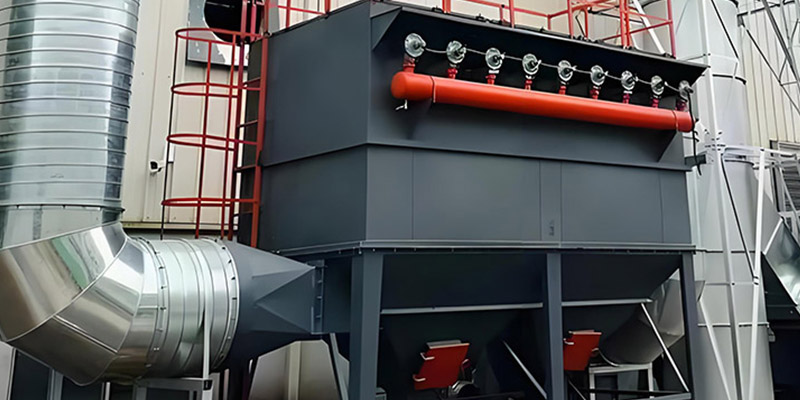
Large bag filters require a “multi-unit modular” design. The air volume handled per single unit should be controlled between 50,000 and 80,000 m³/h. This prevents airflow maldistribution and structural deformation caused by an oversized single unit.
-
Unit Division:
-
A 65 t/h boiler (air volume approx. 120,000 m³/h) uses 2 units.
-
A 300 MW unit (air volume approx. 400,000 m³/h) uses 6-8 units.
-
Connect these units with a manifold to ensure airflow distribution deviation ≤ ±5%.
-
-
Casing Structure:
-
Use welded Q345R steel plates (thickness 12-16 mm).
-
Space columns ≤ 3 m apart.
-
Install reinforcing beams on the top (deflection ≤ L/500).
-
Ensure the structure can withstand the combined load from filter bags, dust, and maintenance (total load ≥ 5 kN/m²).
-
-
Anti-corrosion Treatment:
-
Spray the inner wall with a polyurea coating (dry film thickness 1.2 mm).
-
Apply arc transition and reinforced anti-corrosion to weld seams.
-
Guarantee a corrosion-resistant life ≥ 5 years in sulfur-containing flue gas (SO₂ ≤ 3000 mg/m³).
-
(B) Adaptation of Filter Bags and Cleaning System
The filter bags and cleaning system must match high-flow operating conditions to balance filtration efficiency and cleaning energy consumption.
-
Filter Bag Configuration:
-
Use Φ160 × 6000 mm filter bags (single bag filtration area 3.01 m²).
-
Select the material as 550 g/m² PPS+PTFE composite filter media (heat resistance 190°C).
-
Space the bags 350 mm apart to prevent dust bridging.
-
Calculate the number of bags per unit using this formula: Air Volume ÷ (0.8 m/min × 60 × Single Bag Area).
-
-
Cleaning System:
-
Employ 3-inch solenoid pulse valves (response time ≤ 0.03 seconds).
-
Let each valve control 6 filter bags at a blowing pressure of 0.55-0.6 MPa.
-
Adopt compartmentalized offline cleaning. This means cleaning only one unit at a time while others operate normally. Consequently, it avoids system-wide resistance fluctuations.
-
(C) Integrated Flue Gas Pretreatment
For high dust loads, it is necessary to integrate efficient pretreatment devices at the filter inlet.
-
Pre-dust Removal:
-
Connect a cyclone separator in series within the inlet duct (separation efficiency ≥ 85% @ 30 µm).
-
This removes 30-40% of coarse dust particles (≥ 50 µm), thereby reducing the load on the main filter media.
-
-
Temperature Control Module:
-
Install a flue gas heat exchanger.
-
Cool the high-temperature flue gas (250-300°C) down to 160-180°C (the safe range for PPS filter media).
-
Ensure the heat exchange efficiency ≥ 90% and the temperature fluctuation ≤ ±10°C.
-
-
Airflow Distribution:
-
Set up a three-stage flow guide at the inlet (diffusion section → guide plates → perforated flow equalization plate).
-
Use an equalization plate with an opening ratio of 35-40%.
-
Ensure the deviation in face velocity across the filter bags ≤ ±3%, which minimizes local abrasion.
-
II. Core Mechanisms for Resistance Control
(A) Resistance Composition and Critical Limits
The total resistance of a large bag filter consists of three parts:
-
Inherent Bag Resistance: 100-200 Pa
-
Primary Dust Cake Resistance: 300-500 Pa
-
Residual Resistance after Cleaning: 400-600 Pa
The target for total resistance control is 1200-1800 Pa. Exceeding 2000 Pa will cause a sharp increase in induced draft fan energy consumption.
-
Normal Range: 1200-1500 Pa (dust cake thickness on bag surface: 1-2 mm). Here, filtration efficiency is ≥ 99.9%.
-
Warning Range: 1500-1800 Pa. Strengthen the cleaning process at this stage.
-
Emergency Range: > 1800 Pa. Shut down for inspection immediately to prevent fan overload.
(B) Tiered Resistance Control Strategy
Apply differentiated control based on the resistance stage.
| Resistance Stage | Control Mode | Key Parameter Settings | Notes |
|---|---|---|---|
| Low Resistance (< 1200 Pa) |
Time Control | Cleaning cycle: 10-12 minutes | Maintains a stable primary dust cake (can improve fine particle capture by 5-8%). |
| Medium Resistance (1200-1500 Pa) |
Resistance Trigger | Activates cleaning upon reaching the set value. Blowing pressure: 0.55 MPa | Ensures residual resistance after cleaning ≤ 600 Pa. |
| High Resistance (1500-1800 Pa) |
Enhanced Cleaning | Blowing pressure: 0.6 MPa. Cycle shortened to 8 minutes. | Also, check pre-dust removal effectiveness. Clean the cyclone if coarse dust removal rate is < 30%. |
(C) Optimization of Key Parameters
-
Air-to-Cloth Ratio:
-
Strictly control it between 0.7 and 0.8 m/min (approx. 0.75 m/min for a 65 t/h boiler).
-
Remember, increasing the ratio by 0.1 m/min raises resistance by 150-200 Pa.
-
-
Cleaning Sequence:
-
Implement “unit-rotational cleaning”.
-
Keep the interval between cleaning adjacent units ≥ 3 minutes.
-
This prevents total resistance fluctuations > 200 Pa.
-
-
Air Supply Quality:
-
Treat compressed air with a “refrigerated dryer + precision filter” system.
-
Ensure the dew point ≤ -40°C and oil content ≤ 0.01 mg/m³.
-
This prevents abnormal resistance caused by moisture combining with dust.
-
III. Prevention and Adjustment of Resistance Anomalies
(A) Common Causes and Countermeasures for Resistance Anomalies
| Anomaly | Possible Cause | Corrective Action |
|---|---|---|
| High Resistance (> 1800 Pa) |
Insufficient Cleaning | Check pulse valves. Increase pressure to 0.65 MPa and perform 3 consecutive cleaning cycles. |
| Bag Blinding/Bridging | For high humidity (moisture content >15%), activate a rotary dehumidifier. Replace bags with reduced hydrophobicity (contact angle < 100°). | |
| Pipeline Blockage | Check ash discharge from the pre-dust removal hopper. Clean the screw conveyor (ensure hopper level ≤ 1/2). | |
| Low Resistance (< 1000 Pa) |
Bag Breakage | Locate broken bags via light transmission or smoke testing. Replace them (ensure breakage rate per unit ≤ 0.1%). |
| Over-cleaning | Reduce blowing pressure to 0.5 MPa and extend cycle to 12 minutes to avoid damaging the primary dust cake. |
(B) Dynamic Adjustment System
Large bag filters need an intelligent resistance regulation system for real-time response.
-
Monitoring Module:
-
Install differential pressure transmitters at the inlet/outlet of each unit (range 0-3000 Pa, accuracy ±1%).
-
Collect data every 10 seconds and trigger automatic alarms for anomalies.
-
-
Adjustment Logic:
-
When resistance deviates ±200 Pa from the setpoint: Automatically adjust cleaning parameters (pressure ±0.05 MPa, cycle ±2 minutes).
-
When deviation reaches ±300 Pa: Activate the standby cleaning unit.
-
-
Linkage Control (with Boiler Load):
-
When load > 80% (dust concentration rises): Lower the preset resistance upper limit by 100 Pa.
-
When load < 50%: Appropriately increase the air-to-cloth ratio to 0.85 m/min to avoid excessively low resistance.
-
IV. Application Case and Performance Validation
Design and Operational Data for a Bag Filter on a 300 MW Coal-fired Unit (Air Volume 420,000 m³/h):
-
Structural Configuration:
-
8 units (52,500 m³/h per unit).
-
14,000 filter bags total (Φ160×6000mm, PPS+PTFE media).
-
1,750 three-inch pulse valves.
-
-
Resistance Control:
-
Normal operating resistance: 1300-1450 Pa.
-
Cleaning pressure: 0.55 MPa, cycle: 10 minutes.
-
-
Operational Performance:
-
Outlet dust concentration: 3-5 mg/m³.
-
Induced draft fan power consumption: 8% lower than the design value.
-
Resistance fluctuation over 12 months of continuous operation: ≤ ±100 Pa.
-
Filter bag integrity rate: 99.8%.
-
V. Coordinated Optimization of Structure and Resistance
-
Unit Quantity vs. Resistance:
-
Increasing unit count reduces load per unit. For example, 8 units show 100-150 Pa lower resistance than 6 units.
-
However, the initial investment increases by about 15%. Therefore, balance capital cost with energy consumption.
-
-
Bag Length vs. Resistance:
-
A 6m bag provides 17% more filtration area and 8% lower unit resistance than a 5m bag.
-
But, ensure the cleaning airflow reaches the bag bottom (blowing tube should be 300 mm from the bottom).
-
-
Airflow Velocity vs. Layout:
-
Optimize guide plate angles (30°) and equalization plate openings using CFD simulation.
-
This reduces local velocity deviation from ±8% to ±3%, improving resistance uniformity by 20%.
-
VI. Conclusion
The structural design of bag filters for large coal-fired boilers must focus on “modularity and high stability”. Concurrently, resistance control requires establishing a closed-loop system of “prevention – monitoring – adjustment”.
Practice proves that coordinated optimization of structural layout and resistance control achieves ultra-low emissions (dust ≤ 10 mg/m³). Furthermore, it confines the annual power consumption of the induced draft fan to within 2% of the boiler’s total energy consumption. Ultimately, this provides reliable support for the efficient and environmentally friendly operation of large coal-fired units.