Cyclone dust collectors are simple in structure, stable in operation and high-temperature resistant, making them the most commonly used pre-treatment or primary dust collection equipment in industrial dust removal. Choosing the wrong model will not only result in low efficiency and high energy consumption, but also accelerate equipment wear and increase maintenance costs. This article provides a directly applicable technical guide for selecting cyclone dust collectors from four aspects: working principle, applicable scenarios, key selection principles and step-by-step procedures.
1. How Does a Cyclone Dust Collector Work?
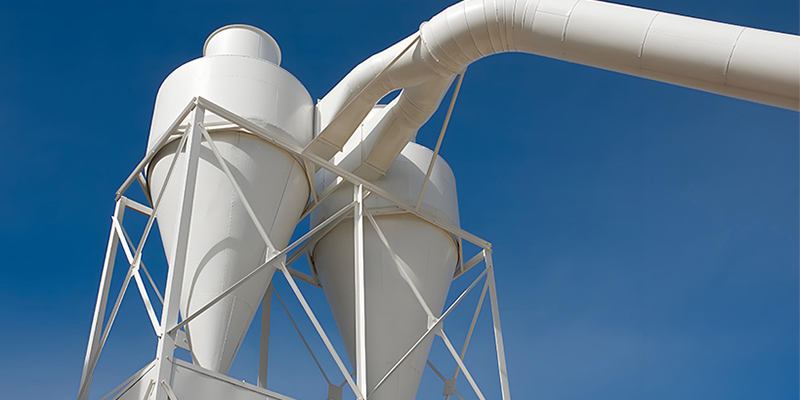
Understanding the working principle is the first step in correct selection. The core of a cyclone dust collector is to separate dust particles from air or gas flow by using centrifugal force. Its structure is simple, but the law of air flow movement directly affects the dust collection efficiency.
Structure Composition and Air Flow Direction Explanation:
In a typical countercurrent tangential inlet cyclone dust collector, its core structure and internal air flow movement are as follows:
Main Components:
The equipment is mainly composed of a cylindrical body, a conical body, a tangential air inlet pipe, an air outlet pipe and an ash discharge port. All components work together to ensure stable rotation of air flow and effective separation of dust.
Core Working Process:
-
Formation of External Cyclone Flow: Dust-laden gas enters the dust collector at high speed through the tangential air inlet pipe. The air flow changes from linear movement to circular movement, rotating from top to bottom along the inner wall of the cylindrical body to form a strong external cyclone flow, similar to a high-speed rotating tornado, which provides the centrifugal force foundation for dust separation.
-
Separation Process: During high-speed rotation, centrifugal force throws dust particles with higher specific gravity onto the inner wall of the dust collector. Once the particles come into contact with the wall, they lose inertia and slide down along the wall into the conical body driven by gravity and air flow, and finally are discharged from the ash discharge port, completing the preliminary separation of dust.
-
Formation of Internal Cyclone Flow: After the rotating and descending external cyclone flow reaches the bottom of the conical body, it moves closer to the center due to the contraction of the cone. According to the principle of constant torque, its tangential speed is further increased, and then the air flow changes direction and rotates from bottom to top in the same rotation direction to form an ascending internal cyclone flow.
-
Air Discharge: The purified gas is discharged from the dust collector through the air outlet pipe, completing the entire dust collection cycle.
Supplementary Explanation on Air Flow:
In addition to the above mainstream gas, there are two special air flows worth noting, whose movement laws directly affect the separation effect of fine dust:
-
Secondary Flow: A small part of the gas entering from the air inlet pipe sometimes flows toward the top cover and then flows downward along the outside of the air outlet pipe, which is an auxiliary air flow.
-
Backflow Zone: When this part of the gas reaches the lower end of the air outlet pipe, it reverses upward and is discharged together with the internal cyclone flow. Fine dust scattered in this small air flow is also easy to be carried away, which is crucial for understanding the escape law of fine dust and optimizing selection.
2. When is a Cyclone Dust Collector Most Effective?
The core of selection is to accurately match the advantages of the dust collector with the actual working conditions, avoiding “overkill” or “improper selection”. Under the following conditions, cyclone dust collectors are the most effective and economical choice. At the same time, their unsuitable scenarios are clearly defined to help avoid selection misunderstandings:
Optimal Applicable Working Conditions:
-
Handling High-Density Dust: It is good at separating high-specific-gravity particles such as metal powder, sand and gravel or minerals. Such dust is easy to separate from air flow under the action of centrifugal force, with outstanding dust collection efficiency.
-
Handling Coarse Particle Dust: For particles larger than 10 microns (µm), the dust collection efficiency is very high; for particles smaller than 5 microns, unless a special high-efficiency (but small-diameter) cyclone dust collector is used, the efficiency will decrease significantly.
-
Application in High-Temperature Working Conditions: Unlike baghouse dust collectors, cyclone dust collectors themselves have no temperature limit (only restricted by the temperature resistance of materials), making them an ideal dust collection choice for high-temperature environments such as kilns, boilers and dryers.
-
As a Pre-Dust Collector: Using a cyclone dust collector before a baghouse or cartridge dust collector to remove large particles and highly abrasive dust is the most efficient application method. This can protect expensive final filtration equipment, reduce wear and clogging, and lower long-term maintenance costs.
-
Handling High-Concentration Dust: It can handle very high inlet dust concentration without clogging, adapting to industrial scenarios with high dust load.
Unsuitable Working Conditions:
For working conditions with high humidity, easy dust adhesion to walls, fine dust (<5μm) as the main component, and extremely high emission accuracy requirements, it is not recommended to use cyclone dust collectors alone; they can be used with other high-efficiency dust collection equipment.
3. Key Technical Principles for Cyclone Dust Collector Selection
When selecting a cyclone dust collector, the following six principles can be used as a checklist to be implemented one by one to ensure scientific, efficient and energy-saving selection and avoid missing core parameters:
-
Matching Air Volume: The handling capacity of the dust collector must be accurately matched with the actual working condition gas flow (the value corrected by temperature and pressure). When handling large air volume, it is recommended to use multiple small-diameter cyclone dust collectors in parallel instead of a single large unit — a smaller diameter can provide higher separation efficiency and avoid insufficient centrifugal force of large-diameter equipment.
-
Controlling Inlet Air Velocity: As one of the core parameters, the inlet air velocity should be maintained between 18 and 23 meters per second to balance efficiency and energy consumption:
-
Below 18 m/s: Centrifugal force weakens, dust collection efficiency decreases significantly, and dust cannot be effectively separated.
-
Above 23 m/s: Resistance loss (energy consumption) increases significantly, while the efficiency improvement is not obvious. At the same time, it will accelerate the wear of the equipment inner wall and shorten the service life.
Checking Cut Size: Ensure that the cut size of the dust collector (i.e., the particle diameter corresponding to 50% efficiency) is slightly smaller than the dust particle diameter to be removed, avoiding ineffective separation of target dust.
Minimizing Resistance Loss: Choose a design that balances high efficiency and low resistance to reduce fan energy consumption and save long-term operating costs.
Ensuring Air Tightness: The ash discharge valve (such as a star discharger) must ensure 100% air tightness. Even a small leak (5-10%) at the bottom will re-entrain the separated dust into the ascending internal cyclone flow, leading to a sharp drop in dust collection efficiency. This is an easily overlooked but highly influential point after selection.
Considering Explosion-Proof Measures: For flammable and explosive dust (such as coal powder and wood chips), the dust collector must be equipped with an explosion-proof door to avoid potential safety hazards and comply with industrial safety standards.
4. Step-by-Step Selection Process
Following the following five-step process can complete scientific selection planning, ensuring that each step is in line with actual working conditions and avoiding selection mistakes:
-
Step 1: Calculate Gas Flow Rate Accurately determine the total gas volume under the working conditions to be handled. Temperature, humidity and pipeline air leakage coefficient must be considered to avoid over-sizing or under-sizing due to deviations in flow calculation.
-
Step 2: Determine Diameter and Arrangement Method Calculate and select the appropriate dust collector diameter according to the total air volume and target air velocity (18-23 m/s). If the calculated diameter is too large (usually exceeding 1000 mm), it is necessary to plan for parallel arrangement of multiple units to ensure separation efficiency.
-
Step 3: Verify Performance Parameters Verify the separation efficiency and resistance loss for specific dust through the performance chart provided by the manufacturer. Refer to the following standard parameter comparison table to quickly match the suitable model: Model TypeInlet Air Velocity (m/s)Resistance Loss (Pa)Cut Size (μm)Applicable Working ConditionsHigh-Efficiency Type20-231200-15003-5Fine dust, used as final dust collectorGeneral-Purpose Type18-20800-10008-15Wood chips, grains, general industrial dustLarge-Capacity Type16-18400-70015-30Pre-dust collector, handling high-concentration load
-
Step 4: Select Ash Discharge Valve Choose a robust, durable and air-tight rotary ash discharge valve (star discharger) to ensure continuous and stable ash discharge, avoiding impact on dust collection efficiency due to poor ash discharge or air leakage.
-
Step 5: Design Parallel Pipeline System If multiple dust collectors are used in parallel, the design of the pipeline system must ensure uniform air flow distribution. Uneven air flow will cause “cross flow” between dust collectors, greatly reducing the total dust collection efficiency and increasing operating energy consumption.
Summary
When choosing a cyclone dust collector, remember these three points to easily avoid selection misunderstandings and improve use effect:
-
1. Coarse particles, high temperature and high concentration working conditions are the most cost-effective, adapting to its core advantages of simple structure and high temperature resistance;
-
2. Keep the air velocity stable at 18–23 m/s to balance dust collection efficiency and operating energy consumption, avoiding excessively high or low air velocity;
-
3. Ensure no air leakage at the bottom and 100% air tightness of the ash discharge valve, so that the efficiency will not “fail”.
Core Review: Cyclone dust collectors separate high-specific-gravity dust by using centrifugal force generated by vortex air flow; they are best suited for scenarios with coarse particles, high temperature and high concentration dust, or used as pre-dust collectors; the core of selection is to match air volume, control air velocity and ensure air tightness. Scientific selection can be completed by following the step-by-step process.