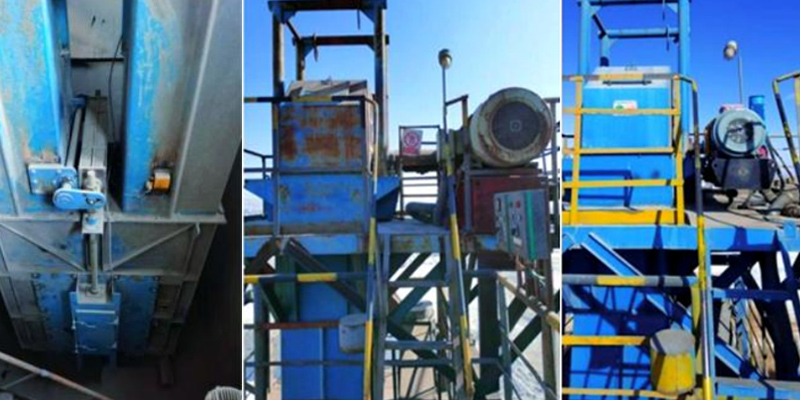
Flap valves play a critical role in the cement preheater system. They directly control how smoothly material flows. Furthermore, they prevent hot gas from the lower-stage cyclone from leaking into the upper-stage cyclone. This ensures high gas-solid separation efficiency for each cyclone. Essentially, flap valves serve two core purposes. First, they provide an air lock. Second, they ensure stable material flow and effective dispersion.
The industry currently uses three main types of flap valves. These are the double-layer flap valve, the standard single-flap valve, and the single-body double-flap valve. Plants often install double-layer valves on the C1 discharge pipe to improve the air lock. They typically use single-layer valves for the C2 to C5 discharge pipes. So, which type should you choose? The following analysis explores the characteristics of each type.
1. Analysis of Different Flap Valve Types
1.1 Standard Single-Flap Valve: Ensures Consistent Material Distribution
This is the most common and historically used design. Manufacturers have made various improvements to the shaft, bearings, and placement. Their goal is always to prevent blockages and reduce air leakage. However, the core material flow principle remains unchanged.
You must install this valve with the flap plate facing the material flow direction. This design guides the material along the bottom of the chute. It streamlines the material stream. Consequently, the material lands concentrically on the distribution plate, achieving optimal dispersion. You should also avoid any bends in the chute between the valve and the distribution plate. Ideally, the valve should face the distribution plate directly. Therefore, this valve type excels at stabilizing flow and guaranteeing effective material distribution.
1.2 Single-Body Double-Flap Valve: The Trade-off Between Superior Air Lock and Unpredictable Flow
This design is an innovation. Its main advantage is exceptional air lock performance. Tests show its sealing can be so effective it’s “drip-tight.” In practice, factors like heat deformation, coating, or material jamming can reduce performance. Nonetheless, its inherent sealing advantage is undeniable.
However, a key drawback comes from its design. Material tends to fall down the center of the pipe. If the counterweights are unbalanced, or if coating builds up unevenly on the flaps, the flow direction becomes unpredictable. This often causes segregated material flow on the distribution plate, hurting dispersion. If the installation height above the distribution plate is sufficient, this effect may lessen. In summary, this valve offers a superior air lock, but you must manage the risk of unpredictable material flow.
2. The Art of Adjusting Counterweights
Adjusting the counterweight is a crucial and precise task. It directly impacts feeding uniformity and the air lock effect. Some companies use different counterweight settings during startup and normal operation. This is a very rigorous practice and is highly recommended.
You must adjust the counterweight based on the installation height and the observed material dispersion. If the valve is installed high and the material impacts the opposite side, you should increase the counterweight. This reduces the impact force. Another key recommendation is to set the valve lever horizontally when the valve is fully closed. As material hits the flap, the lever moves above the horizontal line. During closing, the lever has the longest possible length. This creates the highest closing force and the fastest shut-off. This “rapid, slight movement” ensures continuous, even feeding. Simultaneously, it minimizes the time for air leakage, achieving the best air lock.

3. Comprehensive Application Recommendations
Based on this analysis, we provide the following selection and installation advice:
-
C1/C2 Discharge Pipes: Prioritize single-body double-flap valves. They enhance the air lock. Avoid connecting two separate single-flap valves in series. This saves vertical space and protects dispersion performance.
-
C4 to Calciner & C5 Discharge Pipes: We strongly recommend standard single-flap valves. In these locations, uniform material distribution and smooth flow are more critical than a perfect air lock. Stable flow is essential for efficient combustion in the calciner and for preventing increased resistance in the smoke chamber.
-
C2/C3 Discharge Pipes: You can consider single-body double-flap valves here. They improve the air lock and heat transfer efficiency. However, you must closely monitor material distribution and temperature differences between cyclones. If the temperature difference decreases, immediately investigate whether skewed material flow is causing poor distribution.