In the complex operating conditions of a cement plant, damper valves are core components for achieving efficient and safe operation. Incorrect selection can lead to reduced system efficiency, increased energy consumption, and even safety hazards. This article provides an in-depth guide on choosing damper valves for cement plants and answers key related questions.
What is a Damper Valve?
A damper valve is an airflow control device installed in industrial piping systems. It precisely regulates the flow, pressure, and direction of air, flue gas, or dust by adjusting its internal mechanism, such as a butterfly disc or louver blades.
There are two main types:
-
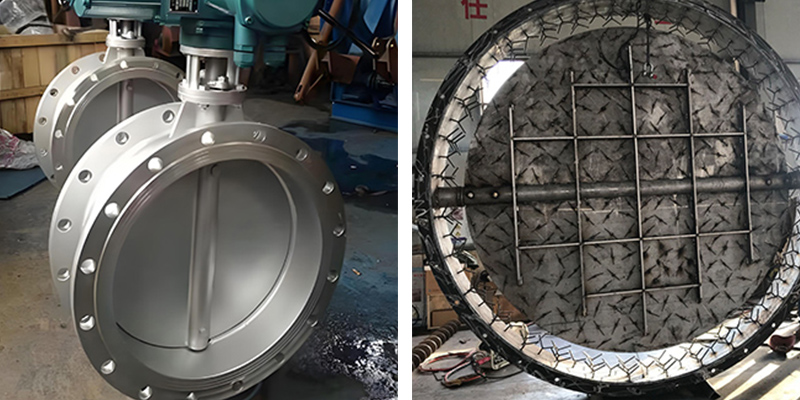
Butterfly Dampers: Compact, single-disc design, ideal for quick on/off and shut-off control.
-
Louver Dampers: Feature parallel multi-blades for fine adjustment, suitable for precise airflow distribution and mixing control.
In cement production, damper valves must withstand high temperatures, heavy dust, and corrosive gases. Their material and structural design directly impact equipment reliability and service life.
What is the Function of a Damper?
The core function of a damper valve in a cement plant is to achieve three key goals through precise airflow control:
1. Process Optimization & Stable Operation
-
Airflow Balancing: In preheater systems, high-temperature dampers balance pressure between cyclones and the calciner, improving raw meal decomposition rates.
-
Precise Temperature Control: In grate cooler systems, electric louver dampers distribute cooling air to each compartment, boosting heat recovery efficiency.
-
Pressure Stabilization: Control butterfly valves at the main ID fan inlet maintain stable system pressure for steady kiln operation.
2. Safety & Risk Control
-
Quick Isolation & Shut-off: Pneumatic quick-closing fire & explosion-proof butterfly dampers in coal mill systems enable emergency shut-off within 1 second.
-
Smoke & Fire Protection: Fire and smoke dampers in ducts meet stringent safety codes.
3. Energy Efficiency & Emission Reduction
-
Reduce Waste: Precise control avoids excessive ventilation, lowering fan power consumption.
-
Optimize Thermal Process: Stabilizing pre-calcination and cooling reduces specific heat consumption for energy savings.
Where are Dampers Used?
Key cement plant process stages have specific requirements for damper selection and application.
| Application Area | Key Challenges | Recommended Damper Type | Key Performance Needs |
|---|---|---|---|
| Preheater & Calciner | 800-1200°C, alkali corrosion, thermal cycling | Ultra-High Temp Butterfly/Inclined Louver Damper (heat-resistant alloy/water-cooled) | Resists heat distortion, thermal shock, long life |
| Rotary Kiln | Highest temperature zone, complex combustion | Specialized Ultra-High Temp Dampers for kiln inlet/outlet | Extreme reliability, sustained high-temp endurance |
| Coal Mill System | Flammable/explosive, abrasive coal dust | Pneumatic Quick-Closing Fire/Explosion-Proof Butterfly Damper (abrasion-resistant seal) | Millisecond response, tight seal, explosion-proof certification |
| Grate Cooler | Hot, abrasive clinker dust, high air volume | High-Temp Electric/Pneumatic Louver Dampers (per-compartment control) | Abrasion-resistant, good control linearity, high reliability |
| Dust & Waste Gas Treatment | Dust-laden, humid SO₂ gases, varying conditions | Anti-corrosion Coated/Stainless Steel Control Butterfly Valves for main fan & bypass | Corrosion-resistant, low leakage, adapts to condition changes |
5-Step Professional Selection Method
Step 1: Define Process Needs & Operating Parameters
First, specify these details:
-
Media Type: Air, hot gas, coal dust, or corrosive gas? What is the temperature range (e.g., <120°C, 120-450°C, 450-700°C, 700-1200°C)?
-
Control Objective: On/Off shut-off, precise modulation, or fast response?
-
Duct Parameters: Size, shape (round/square), space constraints.
-
Control Method: Manual, Electric, or Pneumatic actuation? Integration with DCS/PLC?
Step 2: Match Valve Type & Design
-
For On/Off & Shut-off: Choose Butterfly Dampers. They are simple and seal well, ideal for coal mill isolation and fan inlet valves.
-
For Fine Control & Distribution: Choose Louver Dampers. Their multi-blade design allows 0-100% linear control for grate cooler compartments and preheater balancing.
-
For Extreme Heat: Always select the Ultra-High Temperature series. Consider water-cooled jackets or special alloys.
Step 3: Select Material & Sealing
-
Body Material:
-
Carbon Steel: For temperatures <450°C in non-corrosive gas. Cost-effective.
-
Stainless Steel (304/316): For corrosive environments and high standards.
-
Heat-Resistant Alloy: For high-temperature areas like the preheater and kiln.
-
-
Seal Class: Cement plant dust requires low-leakage design. Use metal hard seals for critical shut-off (e.g., coal mill). Use elastic seals for control points to balance cost and performance.
Step 4: Determine Actuation & Control
-
Manual Actuators: Lowest cost. Use for infrequent adjustment or backup isolation.
-
Electric Actuators: Highest control precision. Integrate easily with automation. Use for applications needing precise modulating control, like grate cooler dampers.
-
Pneumatic Actuators: Fast response, high reliability. Best for high-temperature, humid, or explosive areas like coal mills.
Step 5: Evaluate Manufacturer Expertise & Service
Choose a manufacturer who demonstrates:
-
Industry Experience: Proven cement plant case studies and understanding of specific process needs.
-
Customization Capability: Ability to provide non-standard designs.
-
Quality Control: Robust welding, seal testing, and high-temperature testing.
-
Technical Service: Full-cycle support from selection and installation to maintenance.
Common Selection Mistakes & How to Avoid Them
-
Mistake 1: Ignoring Temperature’s Impact on Material
-
Problem: Using standard carbon steel valves above 450°C causes rapid deformation and failure.
-
Solution: Always select material grade based on maximum media temperature. Account for thermal expansion.
-
-
Mistake 2: Over-Prioritizing Low Initial Cost
-
Problem: Choosing simple flap valves over professional dampers saves cost initially but leads to poor control, short life, and higher maintenance/outage costs.
-
Solution: Evaluate Total Cost of Ownership (TCO). Prioritize reliability and energy-saving returns.
-
-
Mistake 3: Underestimating the Dust Environment
-
Problem: Using standard seals in high-dust areas causes valve sticking and severe leakage.
-
Solution: Select designs with abrasion-resistant linings and dust-proof seals. Plan for regular maintenance cleaning.
-